Fiez-vous au Seigneur de tout votre cœur — Le guide complet de Proverbes 3:5 : Signification, versions, langues et pourquoi il devient le cadeau le plus puissant

Les sept mots qui guident l'humanité depuis trois mille ans
« Confie-toi en l'Éternel de tout ton cœur. »
Sept mots. Écrits par le roi Salomon vers 950 av. J.-C. dans l'antique ville de Jérusalem. Recopiés à la main sur des rouleaux de papyrus, puis sur du parchemin, puis sur du papier, avant d'être imprimés dans des millions de bibles, en des centaines de langues, sur tous les continents. Appris par cœur par des enfants dans les écoles du dimanche, les madrasas, les cathédrales et les églises de village. Murmurés dans les chambres d'hôpital, prononcés lors des funérailles, inscrits sur les murs des maisons et gravés dans un métal qui survivra à tous ceux qui vivent aujourd'hui.
Sept mots qui n'ont jamais cessé d'être vrais.
Ceci est le guide complet de Proverbes 3:5, l'un des versets les plus aimés, les plus cités et les plus gravés de toute la Bible. Nous explorerons sa signification hébraïque originelle, toutes les traductions majeures, sa présence dans plus de dix langues, sa pertinence à chaque étape de la vie humaine, et pourquoi ces sept mots — gravés sur un cadeau offert avec amour — deviennent ce qu'il y a de plus puissant qu'une personne puisse offrir à une autre.
Ceci n'est pas un guide de vente. C'est une exploration de l'une des idées les plus profondes de l'histoire humaine : la forme la plus élevée de sagesse n'est pas l'autosuffisance, mais la confiance.
Explorer : Cadeaux religieux — Fabriqués et gravés à la main par Aladean

Partie 1 : Le verset complet — Proverbes 3:5-6
La plupart des gens connaissent la première moitié. Peu connaissent la seconde. Ensemble, ils forment l'une des déclarations de foi les plus complètes jamais écrites.
Proverbes 3:5-6 (LSG) :
« Confie-toi en l'Éternel de tout ton cœur, et ne t'appuie pas sur ton intelligence ; reconnais-le dans toutes tes voies, et il aplanira tes sentiers. »
Le verset comprend quatre mouvements, chacun s'appuyant sur le précédent :
Mouvement 1 : « Confie-toi en l'Éternel de tout ton cœur »
Pas une confiance partielle. Pas une confiance conditionnelle. Pas une confiance seulement quand tout va bien. Confie-toi de tout ton cœur — tout ton être, les parts qui ont peur et celles qui sont confiantes, celles qui comprennent et celles qui ne comprennent pas. Une dépendance totale et inconditionnelle envers Dieu.
Mouvement 2 : « Ne t'appuie pas sur ton intelligence »
C'est le contrepoint — ce que l'on vous demande de lâcher prise. Vos propres analyses. Vos propres conclusions. Votre propre lecture de la situation. Non pas parce que l'intelligence humaine est sans valeur, mais parce qu'elle est limitée. Nous voyons partiellement. Dieu voit tout.
Mouvement 3 : « Reconnais-le dans toutes tes voies »
Pas seulement pour les grandes décisions. Pas seulement dans les moments spirituels. Dans toutes tes voies — le mardi ordinaire, les choix de routine, les petits moments qui semblent insignifiants mais qui sont, en réalité, le pivot sur lequel tout bascule.
Mouvement 4 : « Et il aplanira tes sentiers »
La promesse. Non pas que le chemin sera facile. Non pas qu'il sera court. Mais qu'il sera droit — avec un but, une direction, menant vers quelque chose de réel. Le Dieu en qui l'on a confiance sera le Dieu qui guide.
Ces quatre mouvements forment ensemble une théologie complète de la confiance — et une philosophie de vie complète.

Partie 2 : L'hébreu original — Ce que « confiance » signifie vraiment
Pour comprendre pleinement Proverbes 3:5, il faut revenir à l'hébreu original, car le mot français « confiance » ne traduit pas entièrement ce que Salomon a écrit.
Le mot hébreu traduit par « confiance » dans Proverbes 3:5 est בְּטַח (batach).
Batach ne signifie pas simplement une croyance intellectuelle ou une confiance cognitive. Il comporte une dimension physique : le sens de projeter tout son poids sur quelque chose, de s'y appuyer complètement, d'être si certain de sa solidité que l'on y repose tout son corps sans réserve.
Imaginez une personne se laissant aller en arrière dans une chaise dont elle est absolument certaine qu'elle la retiendra. Elle ne s'assoit pas sur le bord. Elle ne se soutient pas avec ses propres muscles au cas où. Elle tombe en arrière dedans — complètement, sans réserve, confiant à la chaise tout le poids de son corps.
C'est cela, batach. C'est ce que Salomon nous demande.
Le mot apparaît 120 fois dans la Bible hébraïque. Il est utilisé pour décrire la sécurité d'une ville aux murailles solides, la confiance d'un guerrier qui sait que son bouclier tiendra, la paix d'un enfant dans les bras de sa mère. À chaque usage, le sens fondamental est le même : une dépendance totale, supportant le poids, envers quelque chose qui a fait ses preuves.
Le deuxième mot hébreu clé du verset est שָׁעַן (sha'an) — traduit par « t'appuyer » dans « ne t'appuie pas sur ton intelligence ». Sha'an signifie s'appuyer, se soutenir contre, s'étayer. C'est la même métaphore physique : l'image d'une personne utilisant quelque chose comme une béquille, un soutien, un étai.
Salomon dit : n'utilisez pas votre propre intelligence comme béquille. Ne vous soutenez pas avec votre propre analyse. Au lieu de cela — batach. Projetez tout votre poids sur Dieu. Laissez-Le être l'appui solide sur lequel vous vous reposez.
Le contraste entre batach (confiance en Dieu) et sha'an (s'appuyer sur sa propre intelligence) est au cœur du verset. On ne vous demande pas d'arrêter de réfléchir. On vous demande d'arrêter de faire de votre réflexion l'autorité finale.
Le texte hébreu de Proverbes 3:5 :
בְּטַח אֶל-יְהוָה בְּכָל-לִבֶּךָ, וְאֶל-בִּינָתְךָ אַל-תִּשָּׁעֵן
Betach el-Adonai b'chol-libbecha, v'el-binatcha al-tisha'en

Partie 3 : Chaque version biblique majeure — Ce qui change, ce qui reste, pourquoi c'est important
Proverbes 3:5 a été traduit en anglais plus de fois que presque n'importe quel autre verset des Écritures. Chaque traduction fait des choix différents — et ces choix révèlent différentes facettes du même diamant. Voici chaque version majeure avec des commentaires sur ce qui rend chacune unique.
King James Version (KJV) — 1611
"Trust in the LORD with all thine heart; and lean not unto thine own understanding."
Caractère : Majestueux, formel, ancien. L'utilisation par la KJV de « thine » et de « LORD » en petites majuscules (indiquant le nom divin YHWH) donne à cette version un poids et une solennité qu'aucune traduction moderne n'égale vraiment. Pendant trois siècles, ce fut la version apprise par cœur par les chrétiens anglophones du monde entier. Quand les gens disent « Trust in the Lord » de mémoire, ils citent presque toujours la KJV.
New International Version (NIV) — 1978/2011
"Trust in the Lord with all your heart and lean not on your own understanding."
Caractère : Claire, accessible, contemporaine. La NIV est la traduction biblique moderne la plus vendue au monde et la version la plus utilisée dans les églises évangéliques. Sa clarté en fait le choix le plus populaire pour la gravure — les mots sont immédiatement compréhensibles pour tout lecteur.
English Standard Version (ESV) — 2001
"Trust in the Lord with all your heart, and do not lean on your own understanding."
Caractère : Précise, littéraire, fidèle à la structure hébraïque. Le « do not lean » de l'ESV est une traduction plus directe du commandement négatif hébreu que le « lean not » de la NIV. Préférée par les traditions réformées et presbytériennes.
New Living Translation (NLT) — 1996/2015
"Trust in the Lord with all your heart; do not depend on your own understanding."
Caractère : Chaleureuse, conversationnelle, émotionnellement accessible. Le choix par la NLT de « depend » au lieu de « lean » rend le sens immédiatement clair pour les lecteurs modernes. C'est la version qui ressemble le plus à un ami qui vous parle plutôt qu'à un texte lu.
New King James Version (NKJV) — 1982
"Trust in the Lord with all your heart, and lean not on your own understanding."
Caractère : Le pont entre la majesté de la KJV et la lisibilité moderne. Conserve le rythme et la dignité de la KJV tout en mettant à jour le langage archaïque. Populaire dans les traditions charismatiques et pentecôtistes.
The Message (MSG) — 2002
"Trust God from the bottom of your heart; don't try to figure out everything on your own."
Caractère : Conversationnelle, contemporaine, presque étonnamment directe. La paraphrase d'Eugene Peterson dépouille toute formalité et s'exprime dans le langage de la vie ordinaire. « Don't try to figure out everything on your own » est peut-être la traduction la plus parlante pour le lecteur moderne épuisé par l'excès de réflexion.
Amplified Bible (AMP) — 1965/2015
"Trust in and rely confidently on the Lord with all your heart and do not rely on your own insight or understanding."
Caractère : Expansive, explicative, théologiquement riche. L'Amplified Bible déballe les nuances hébraïques que les traductions à mot unique compressent. « Trust in and rely confidently on » est la traduction anglaise la plus proche de batach — la confiance physique qui porte le poids de l'hébreu original.
Good News Translation (GNT) — 1976
"Trust in the Lord with all your heart. Never rely on what you think you know."
Caractère : Simple, directe, conçue pour les nouveaux lecteurs et les locuteurs non natifs. « Never rely on what you think you know » est une traduction frappante — elle saisit l'humilité épistémologique du verset dans un langage simple.
Christian Standard Bible (CSB) — 2017
"Trust in the Lord with all your heart, and do not rely on your own understanding."
Caractère : Équilibrée, lisible, académiquement rigoureuse. La CSB est de plus en plus populaire dans les contextes baptistes du Sud et évangéliques plus larges. Sa traduction est proche de l'ESV mais légèrement plus accessible.

Partie 4 : Proverbes 3:5 en 10+ langues — Le verset qui franchit toutes les frontières
L'une des choses les plus remarquables concernant Proverbes 3:5 est qu'il a été traduit en plus de langues que presque tout autre texte de l'histoire humaine. La Bible existe en plus de 3 500 langues — et dans chacune d'elles, ce verset porte le même commandement essentiel : projetez tout votre poids sur Dieu. Le voici en dix langues, avec des notes sur la résonance culturelle de chacune.
Hébreu — L'original
בְּטַח אֶל-יְהוָה בְּכָל-לִבֶּךָ
Betach el-Adonai b'chol-libbecha
Note culturelle : En hébreu, le verset fait partie de la tradition de la littérature de sagesse — la même tradition qui a produit Job, l'Ecclésiaste et les Psaumes. Pour les lecteurs juifs, ce verset s'inscrit dans un riche contexte de recherche de sagesse et de relation divine qui remonte jusqu'à Abraham.
Grec — La Septante (LXX)
Πεποιθὼς ἴσθι ἐν ὅλῃ καρδίᾳ ἐπὶ τῷ θεῷ
Pepoithos isthi en holē kardia epi tō theō
Note culturelle : La Septante grecque était la Bible de l'Église primitive — la version citée par les auteurs du Nouveau Testament. Le mot grec pepoithos (participe parfait de peitho) porte le sens d'avoir été persuadé, de reposer dans une conviction déjà établie. La confiance n'est pas un saut dans l'inconnu, mais un apaisement dans ce que l'on sait déjà être vrai.
Latin — La Vulgate
Habe fiduciam in Domino ex toto corde tuo
Note culturelle : La Vulgate latine de Jérôme (achevée en 405 apr. J.-C.) fut la Bible du christianisme occidental pendant plus de mille ans. Fiduciam — le mot latin pour confiance — nous donne les mots « fiduciaire » et « fidélité ». La confiance, dans la tradition latine, est inséparable de la fidélité et de la loyauté. Faire confiance à Dieu, c'est être fidèle à Dieu.
Arabe — للمسيحيين العرب والمسلمين
ثِقْ بِالرَّبِّ مِنْ كُلِّ قَلْبِكَ
Thiq bil-Rabb min kulli qalbik
Note culturelle : La Bible arabe est utilisée par les communautés chrétiennes à travers le monde arabe — au Liban, en Égypte, en Syrie, en Jordanie et au-delà. Le mot arabe thiq (confiance) partage une racine avec les concepts de poids et de solidité — remarquablement proche de l'hébreu batach. Pour les chrétiens arabes, ce verset résonne dans un contexte culturel qui valorise profondément le tawakkul (dépendance envers Dieu) — un concept partagé avec la tradition islamique.
Allemand — Deutsch
Vertraue auf den HERRN von ganzem Herzen
Note culturelle : La tradition biblique allemande passe par la traduction historique de Martin Luther en 1534 — l'un des documents les plus influents de l'histoire littéraire allemande. La traduction de Luther a façonné la langue allemande elle-même. Vertrauen (confiance) en allemand comporte des connotations de confiance personnelle profonde et de fidélité relationnelle — la confiance entre des personnes qui se connaissent bien.
Français — Français
Confie-toi en l'Éternel de tout ton cœur
Note culturelle : La tradition protestante française, façonnée par Calvin et les huguenots, a produit certaines des plus belles traductions bibliques dans n'importe quelle langue. Confie-toi est un mot profondément relationnel — c'est le mot utilisé lorsque vous partagez un secret avec quelqu'un en qui vous avez une confiance totale. Faire confiance à Dieu, en français, c'est s'en remettre à Lui.
Espagnol — Español
Confía en el Señor con todo tu corazón
Note culturelle : L'espagnol est la langue de la plus grande population catholique sur terre. La tradition biblique espagnole est profondément ancrée dans la culture latino-américaine et ibérique. Confía (confier, avoir confiance) porte la même chaleur relationnelle que le français — et dans le contexte de la culture de foi latino-américaine, où la relation personnelle avec Dieu est centrale, ce verset résonne avec une profondeur particulière.
Italien — Italiano
Confida nel Signore con tutto il tuo cuore
Note culturelle : L'Italie est le foyer du Vatican et le centre du christianisme catholique. La tradition biblique italienne est ancienne et riche. Confida (confier, avoir confiance) en italien possède une chaleur et une intimité qui reflètent l'accent culturel italien sur la relation personnelle et la loyauté familiale. Faire confiance à Dieu, en italien, c'est L'intégrer au cercle le plus intime de sa confiance.
Ourdou — اردو
خداوند پر اپنے سارے دل سے بھروسہ رکھ
Khudawand par apne saare dil se bharosa rakh
Note culturelle : L'ourdou est la langue de millions de chrétiens pakistanais et indiens, ainsi que la langue littéraire de l'islam sud-asiatique. Le mot bharosa (confiance, dépendance) est l'un des mots les plus émotionnellement résonnants en ourdou — il apparaît dans la poésie, dans les chansons, dans les expressions les plus profondes de la relation humaine. « Bharosa rakh » — garde la confiance, maintiens la confiance — est un commandement qui porte le poids d'une alliance.
Polonais — Polski
Ufaj Panu z całego swego serca
Note culturelle : La Pologne possède l'une des cultures les plus profondément catholiques au monde — la foi y est inséparable de l'identité nationale, des mouvements de résistance du XXe siècle, et de l'héritage du pape Jean-Paul II. Ufaj (faire confiance, avoir foi en) en polonais comporte des connotations de loyauté et de constance — la confiance de quelqu'un qui n'abandonnera pas son engagement, quelles que soient les circonstances.
Portugais — Português
Confia no Senhor de todo o teu coração
Note culturelle : Le portugais est la langue du Brésil — foyer de la plus grande population catholique du monde et l'une des communautés chrétiennes évangéliques à la croissance la plus rapide sur terre. Confia (faire confiance, confier) en portugais porte la chaleur de la culture de foi brésilienne — expressive, relationnelle, profondément personnelle.

Partie 5 : Ce que signifie réellement « Ne t'appuie pas sur ton intelligence »
La seconde moitié de Proverbes 3:5 est souvent négligée — mais c'est là que le verset devient le plus stimulant, et le plus pertinent pour la vie moderne.
« Ne t'appuie pas sur ton intelligence. »
Nous vivons dans une époque qui idolâtre l'intelligence. Nous avons plus d'informations à notre disposition qu'aucune génération dans l'histoire humaine. Nous pouvons chercher n'importe quelle question, analyser n'importe quelle situation, consulter n'importe quel expert, accéder à n'importe quel point de données — tout cela en quelques secondes, depuis un appareil dans notre poche. Nous avons été formés, dès l'enfance, à nous fier à notre propre analyse. À faire nos recherches. À comprendre les choses.
Et pourtant, Salomon — l'un des hommes les plus sages ayant jamais vécu, un homme dont l'intelligence était légendaire — dit : ne vous appuyez pas dessus.
Il ne dit pas : ne réfléchissez pas. Il ne dit pas : n'utilisez pas votre esprit. Il ne préconise pas l'ignorance ou la passivité. Salomon lui-même était un homme d'une curiosité intellectuelle extraordinaire — il a étudié les plantes et les animaux, écrit des milliers de proverbes, s'est engagé dans les traditions de sagesse des nations environnantes.
Ce qu'il dit est plus subtil et plus radical : ne faites pas de votre propre intelligence l'autorité finale. N'utilisez pas votre analyse comme la fondation sur laquelle vous construisez votre vie. Parce que votre intelligence — aussi sophistiquée soit-elle, aussi bien informée soit-elle — est partielle. Elle est limitée par ce que vous pouvez voir, ce que vous pouvez savoir, ce que vous pouvez prédire. Et l'univers est plus vaste que votre compréhension de celui-ci.
La personne qui s'appuie sur sa propre intelligence est comme quelqu'un qui navigue à la lueur d'une bougie dans un vaste paysage sombre. La bougie est réelle. La lumière est authentique. Mais elle n'illumine qu'un petit cercle autour d'elle — et au-delà de ce cercle, le paysage continue, rempli de choses qu'elle ne peut voir.
La confiance en l'Éternel n'est pas l'abandon de la bougie. C'est la reconnaissance qu'il existe un soleil — et que le soleil voit tout ce que la bougie ne peut voir.

Partie 6 : Pourquoi ce verset résonne à chaque étape de la vie
Ce qui rend Proverbes 3:5 extraordinaire, ce n'est pas seulement sa profondeur, c'est son universalité. Ce verset n'est pas destiné à une seule saison de la vie. Il est pour toutes. Voici comment il s'exprime différemment — et avec la même puissance — à chaque étape du voyage humain.
Au baptême — Le début du voyage
Lorsqu'un enfant est baptisé, il ne peut pas encore comprendre ce qui se passe. Il est amené à l'eau par des personnes qui l'aiment, qui font des promesses en son nom, qui s'engagent à l'élever dans la foi. Proverbes 3:5 est le verset qui gouverne ce moment, car ce sont les parents et les parrains/marraines qui font preuve de confiance au nom d'un enfant qui, un jour, fera confiance par lui-même. C'est le verset qui dit : nous plaçons cet enfant entre les mains de Dieu, car Ses mains sont plus grandes que les nôtres.
À la première communion — La première rencontre
L'enfant qui reçoit la communion pour la première fois rencontre quelque chose qu'il ne peut pas pleinement comprendre. Le mystère de l'Eucharistie n'est pas compréhensible, il est reçu. Et recevoir quelque chose que l'on ne comprend pas entièrement exige exactement ce que décrit Proverbes 3:5 : confiance de tout ton cœur, sans t'appuyer sur ta propre intelligence. Ce verset est la théologie de la première communion rendue personnelle.
À la confirmation — La foi choisie
Le jeune qui est confirmé fait un choix, souvent face à un monde qui ne partage pas sa foi, des pairs qui peuvent ne pas la comprendre, des doutes qu'il n'a peut-être pas entièrement résolus. Proverbes 3:5 est le verset pour ce moment : confie-toi de tout ton cœur, même quand ton intelligence est incomplète. Surtout alors. C'est le verset qui donne la permission de s'engager sans avoir toutes les réponses.
À l'obtention du diplôme — L'avenir inconnu
Le diplômé qui se tient au seuil de sa vie d'adulte fait face à un avenir qui est réellement inconnu. Chaque plan qu'il fait est provisoire. Chaque certitude qu'il a est partielle. Proverbes 3:5 est le verset qui parle directement à ce moment, non pas avec la fausse assurance que tout sera facile, mais avec l'assurance plus profonde que le chemin sera aplani. Que le Dieu en qui l'on a confiance sera le Dieu qui guide.
Au mariage — L'alliance de la confiance
Le mariage est l'institution humaine la plus construite sur la confiance — et la plus mise à l'épreuve par les limites de l'intelligence humaine. Chaque couple qui s'est tenu devant un autel l'a fait avec une connaissance incomplète de ce qui l'attend. Proverbes 3:5 est le verset qui fonde un mariage non pas sur la certitude de ce que le couple sait, mais sur la fidélité du Dieu en qui ils ont tous deux confiance.
Dans la maladie et le deuil — Quand l'intelligence fait complètement défaut
Il y a des moments dans chaque vie où la compréhension fait complètement défaut. Quand le diagnostic tombe. Quand la perte est trop grande. Quand la question "pourquoi" n'a pas de réponse satisfaisante. Ce sont les moments où Proverbes 3:5 n'est pas un simple réconfort, c'est une bouée de sauvetage. Non pas parce qu'il explique quoi que ce soit, mais parce qu'il offre quelque chose de mieux qu'une explication : un point d'appui lorsque vos propres jambes ne peuvent plus vous porter.
À la retraite et à l'heure de l'héritage — Les chemins déjà parcourus
Pour la personne qui regarde en arrière sur une longue vie, Proverbes 3:5 prend une dimension différente. Elle peut voir, maintenant, les chemins qui ont été aplanis, souvent de manières qu'elle n'aurait pu prédire ou planifier. Le verset ne devient plus un commandement pour l'avenir, mais un témoignage sur le passé : J'ai fait confiance, et Il a été fidèle. Les chemins ont été aplanis.

Partie 7 : Pourquoi "Confie-toi en l'Éternel" devient le plus puissant des cadeaux gravés
De tous les versets de l'Écriture, Proverbes 3:5 est parmi les plus fréquemment gravés sur des cadeaux. Il y a des raisons à cela, et elles sont plus profondes que la simple popularité ou familiarité.
C'est une théologie complète en quelques mots. La plupart des versets bibliques nécessitent un contexte pour être pleinement compris. Proverbes 3:5 se suffit à lui-même. Il contient son propre commandement, son propre contrepoint et sa propre promesse. Lorsqu'il est gravé sur un cadeau, il n'a pas besoin d'explication. Il parle de lui-même, complètement et immédiatement.
Il s'adresse à l'expérience humaine universelle de ne pas savoir quoi faire ensuite. Chaque personne, à chaque étape de la vie, fait face à des moments où sa propre intelligence ne suffit pas. Ce verset parle directement à ce moment, non pas avec des banalités, mais avec une alternative spécifique et concrète : faire confiance à Dieu à la place. Ce n'est pas un verset sur la religion. C'est un verset sur la condition humaine.
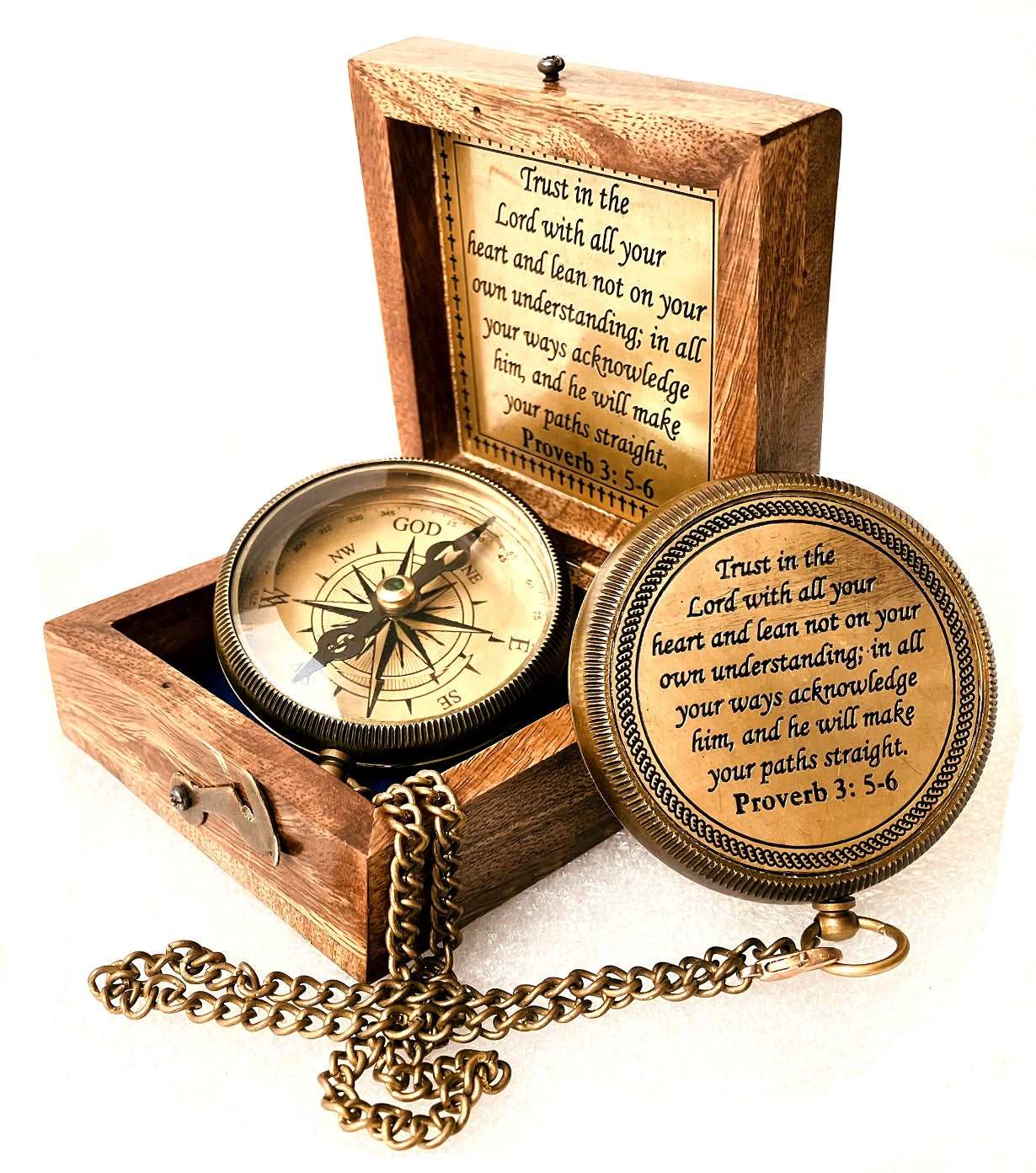
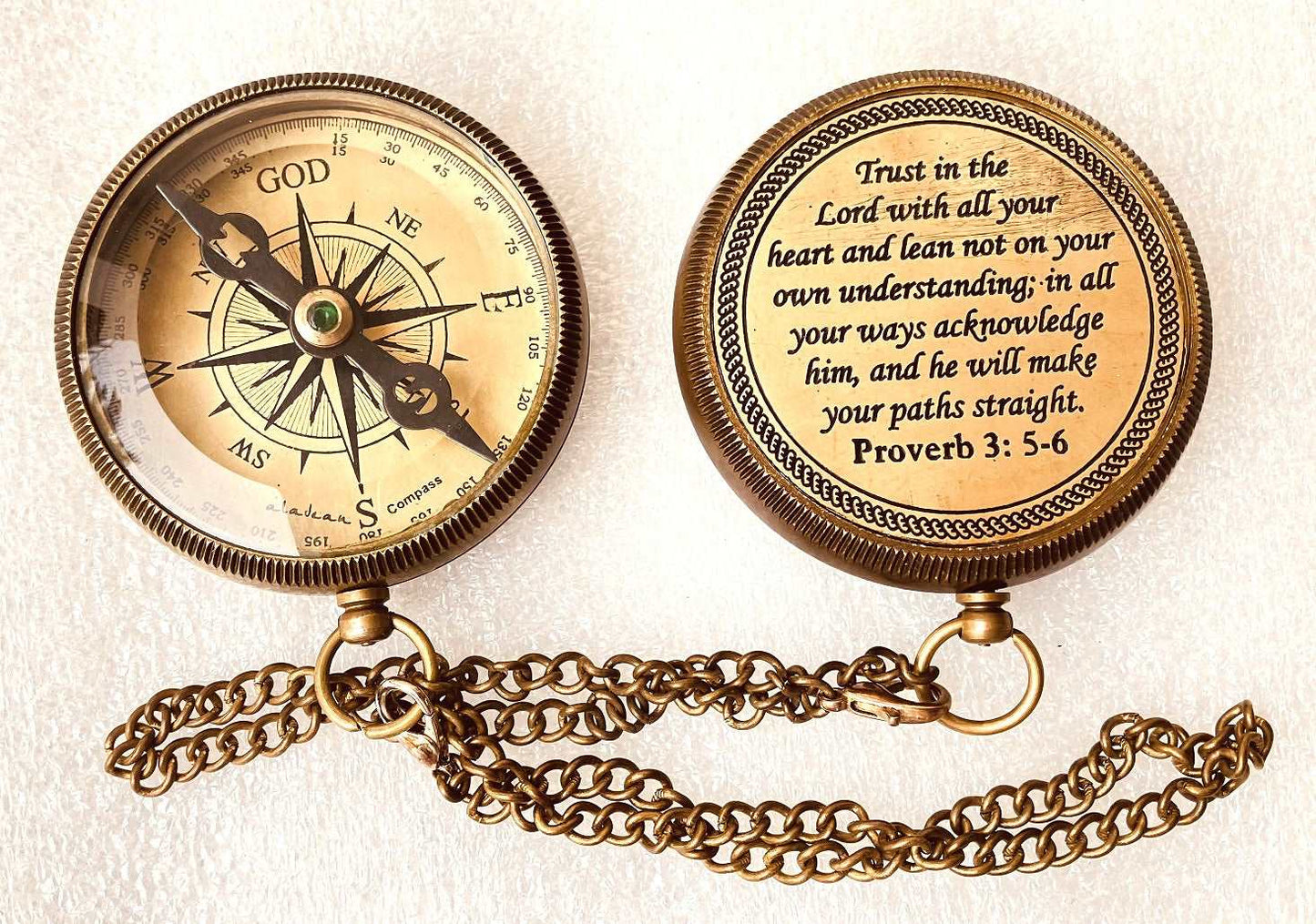
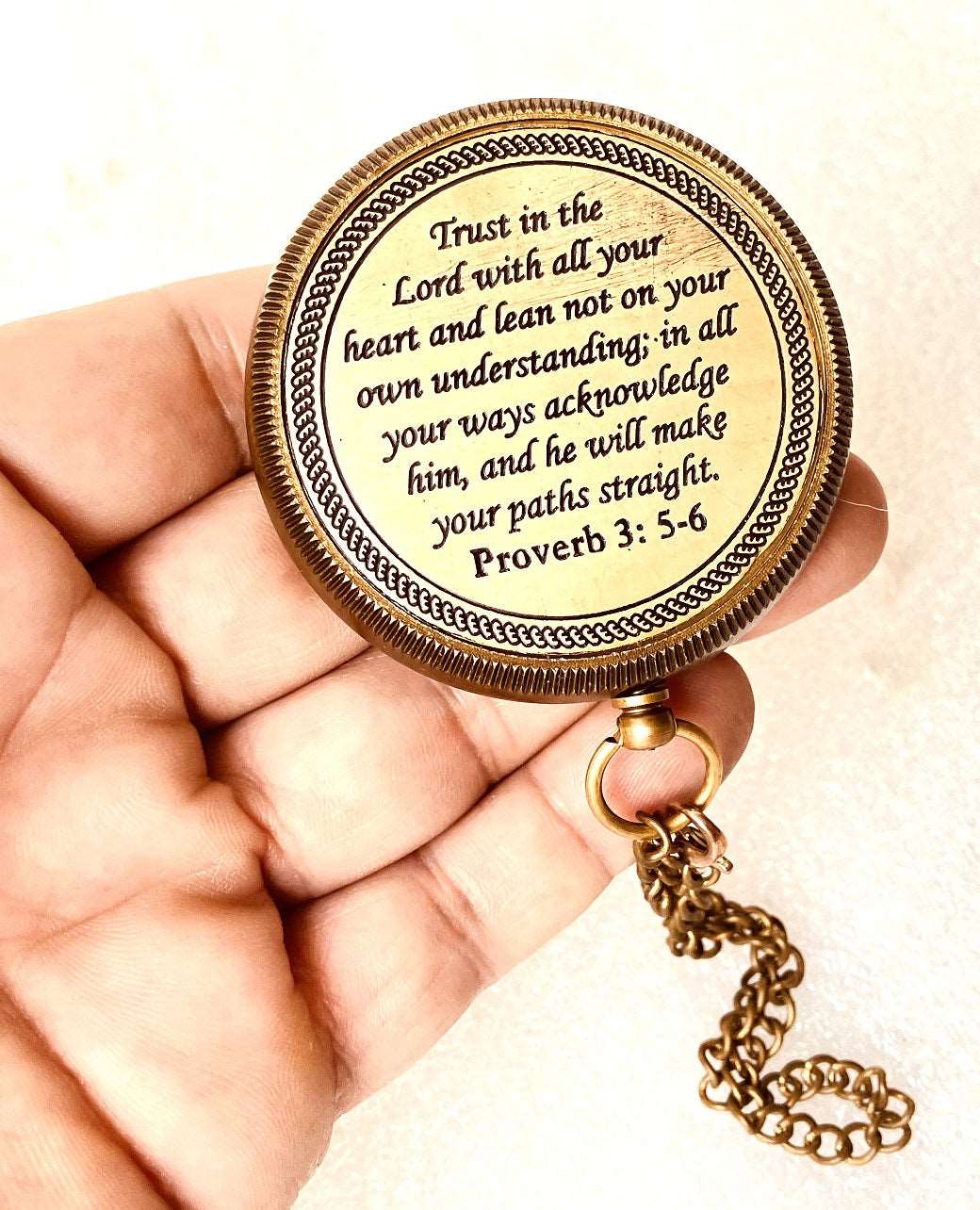
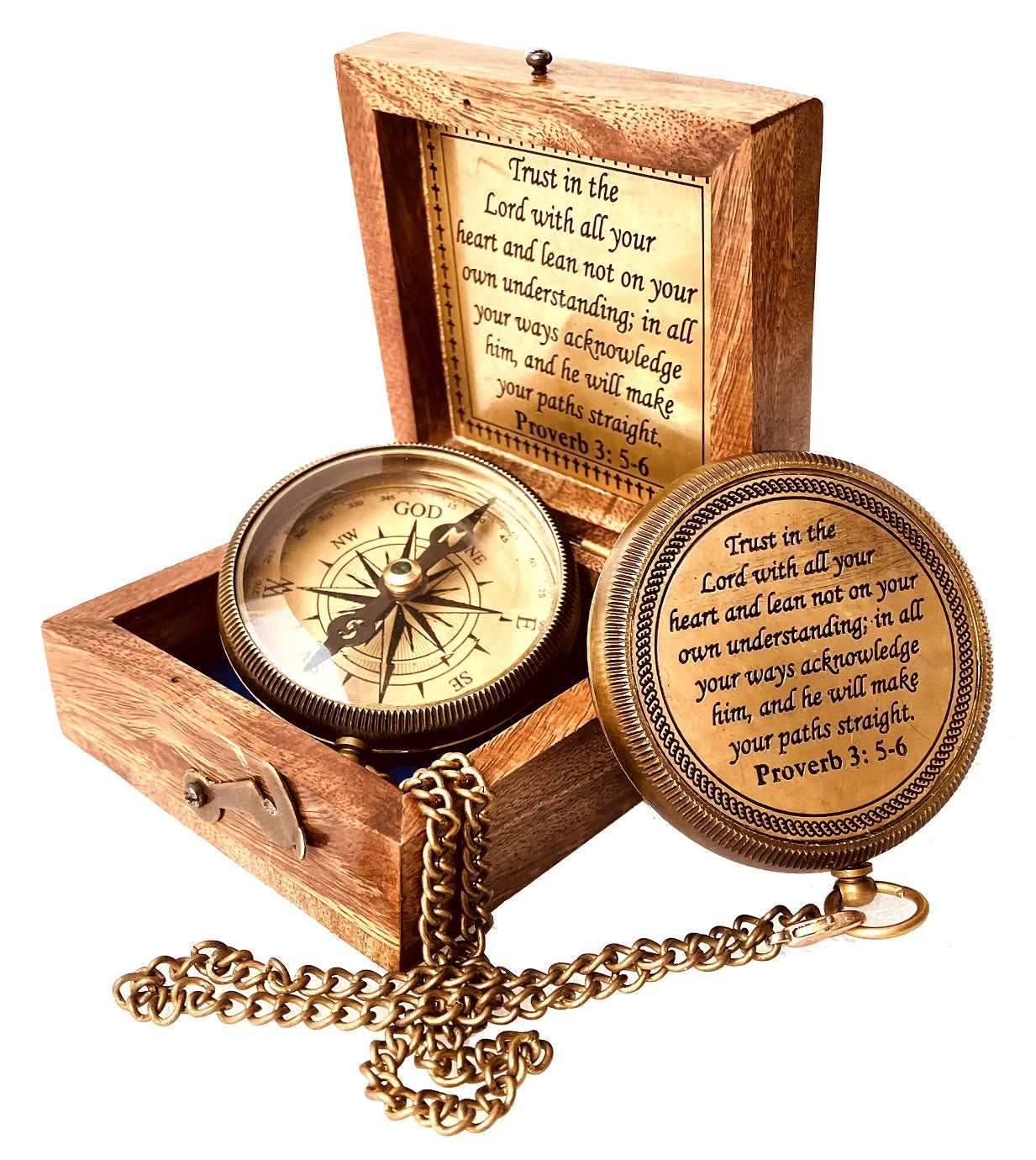
Il est assez court pour être gravé et assez profond pour occuper toute une vie à être médité. Sept mots sur l'extérieur d'une boussole. Sept mots qu'un enfant peut mémoriser et qu'un théologien peut passer sa carrière à explorer. Sept mots qui signifient quelque chose de différent — et quelque chose de plus — à chaque lecture.
C'est un cadeau qui continue de donner. Une carte se lit une fois. Une carte-cadeau est dépensée. Mais des mots gravés dans le métal sont lus à chaque fois que l'objet est pris en main — chaque fois qu'il capte la lumière sur un bureau, chaque fois qu'on le tient dans un moment d'incertitude, chaque fois qu'on le montre à quelqu'un et que l'histoire de qui l'a offert et pourquoi est racontée à nouveau. Le cadeau devient un réceptacle pour le verset, et le verset ne cesse jamais de parler.

Partie 8 : La boussole — Pourquoi ce symbole et ce verset sont indissociables
De tous les objets sur lesquels Proverbes 3:5 a été gravé — et il l'a été sur des bagues, des plaques, des marque-pages, des cadres et d'innombrables autres surfaces — aucun ne porte le verset plus parfaitement qu'une boussole.
La raison n'est pas esthétique. Elle est théologique.
Une boussole ne vous dit pas où vous allez. Elle ne vous donne pas de carte. Elle ne supprime pas la difficulté du terrain et ne raccourcit pas la distance du voyage. Elle fait une seule chose, et elle le fait avec une fiabilité absolue : elle pointe vers le nord. Toujours. Indépendamment du temps, de l'obscurité, de la désorientation, de la peur. L'aiguille trouve le nord et le maintient.
C'est exactement ce que propose Proverbes 3:5. Pas un plan détaillé pour votre vie. Pas de réponses à toutes les questions. Pas la suppression de toutes les difficultés. Mais une direction fiable — un vrai nord qui ne change pas, quelles que soient vos circonstances, vos sentiments ou votre intelligence. Confie-toi en l'Éternel. C'est le vrai nord. Naviguez à partir de là.
Lorsque vous tenez une boussole gravée avec Proverbes 3:5, l'objet et les mots disent exactement la même chose. La boussole dit : il existe un vrai nord, et vous pouvez lui faire confiance absolument. Le verset dit : il existe un Dieu, et vous pouvez Lui faire confiance de tout votre cœur. La forme et le contenu sont unifiés. Le cadeau n'est pas seulement beau, il est cohérent. Il signifie ce qu'il laisse paraître.
C'est pourquoi une boussole "Confie-toi en l'Éternel" n'est pas simplement un cadeau. C'est une théologie rendue physique — une déclaration de foi que l'on peut tenir dans la main, porter dans sa poche, poser sur un bureau et lire dans les moments où la direction est le plus nécessaire.
Notre collection de boussoles "Confie-toi en l'Éternel" :
- Boussole religieuse en laiton — Confie-toi en l'Éternel — La boussole dont l'aiguille pointe vers Dieu. Laiton artisanal, gravé avec Proverbes 3:5. Pour chaque étape importante, chaque saison, toute personne ayant besoin d'un vrai nord.
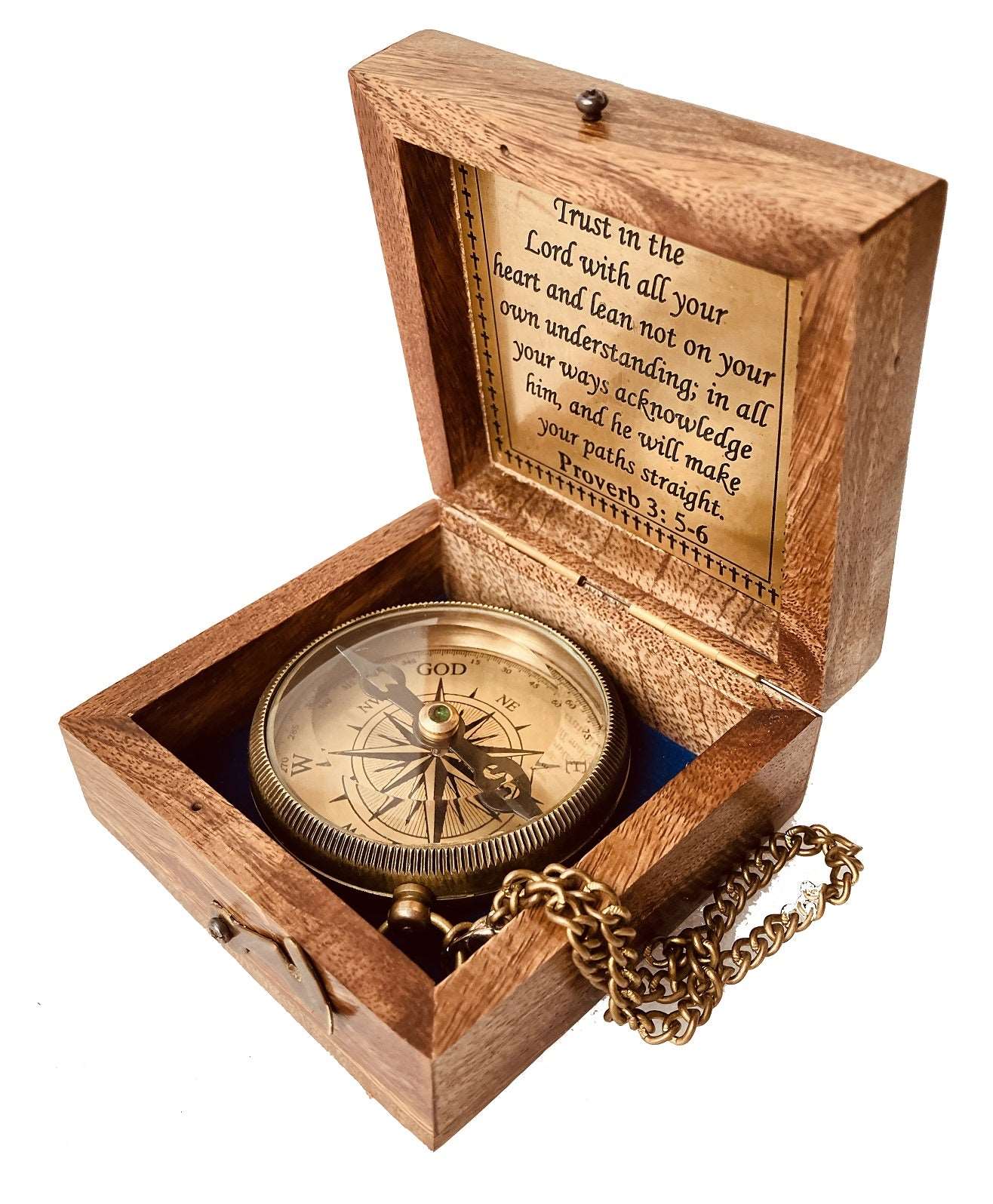
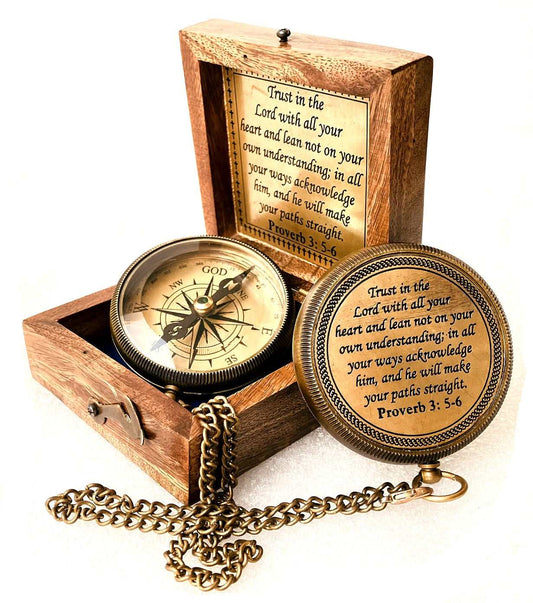
- Confie-toi en l'Éternel de tout ton cœur — Boussole en coffret bois — Le verset complet, gravé sur une boussole en laiton artisanal, présentée dans un coffret cadeau en bois de première qualité. Un cadeau qui arrive comme un héritage.
- Confie-toi en l'Éternel — Boussole gravée Proverbes 3:5-6 — Les deux versets, gravés en intégralité. Le commandement complet et la promesse complète, portés ensemble.
- Boussole "Chemin de Dieu" en coffret bois — Pour la personne qui a besoin qu'on lui rappelle que son chemin est tenu par quelque chose de plus grand qu'elle-même.
- Horloge de bureau vintage avec boussole — Citation religieuse gravée — Pour le bureau, l'étude, le cabinet — un rappel quotidien que le temps et la direction sont tous deux entre les mains de Dieu.
- Boussole en laiton "Dieu guide-moi" — Cadeau religieux de foi — La prière rendue physique. Pour la personne qui commence chaque jour avec cette demande.
Partie 9 : Quand offrir un cadeau Proverbes 3:5 — Chaque occasion, chaque saison
Baptême — La première déclaration de foi sur une vie. Une boussole gravée avec Proverbes 3:5 offerte au baptême devient la première expression physique de la fondation sur laquelle une vie sera construite. Gardée par les parents jusqu'à ce que l'enfant soit assez âgé pour la comprendre, puis offerte à nouveau, avec l'histoire du jour où elle a été donnée pour la première fois.
Première communion — Pour l'enfant qui rencontre Dieu d'une nouvelle manière. Une boussole gravée avec "Confie-toi en l'Éternel de tout ton cœur" est le compagnon parfait — un rappel physique que le Dieu qu'il a rencontré à l'autel est aussi le Dieu qui guidera chaque pas de sa vie.
Confirmation — Le sacrement de la foi choisie mérite un cadeau qui parle du courage de ce choix. "Ne t'appuie pas sur ta propre intelligence" est le verset parfait pour le jeune qui choisit de faire confiance à Dieu dans un monde qui remettra ce choix en question.
Obtention de diplôme — Le diplômé debout au seuil de l'inconnu a besoin exactement de ce que ce verset offre : non pas une carte, mais une boussole. Non pas des réponses, mais une direction. Non pas des certitudes, mais de la confiance.
Noël et Pâques — Les deux grandes célébrations chrétiennes de la fidélité de Dieu. Noël, quand Dieu s'est confié aux mains humaines. Pâques, quand Dieu a tracé le chemin le plus droit à travers la vallée la plus sombre. Les deux occasions sont parfaites pour un cadeau qui déclare : confie-toi en l'Éternel.
Anniversaires marquants — 18, 21, 30, 40, 50 ans — chaque anniversaire marquant est un moment de réflexion sur le chemin parcouru et le chemin à venir. Une boussole gravée avec Proverbes 3:5 est le cadeau qui dit : quel que soit le chemin devant toi, tu as un vrai nord.
Pour quelqu'un en difficulté — Parfois, le cadeau le plus puissant n'est pas pour une célébration, mais pour une crise. La personne confrontée à la maladie, à la perte, à l'incertitude ou à la peur a besoin de ce verset plus que quiconque. Une boussole gravée avec "Confie-toi en l'Éternel de tout ton cœur" n'est pas une banalité. C'est une bouée de sauvetage.
Cadeaux d'entreprise et de leadership — Pour le dirigeant qui a besoin qu'on lui rappelle que la sagesse ne vient pas de soi-même. Pour l'exécutif tenté de ne s'appuyer que sur sa propre intelligence.

Partie 10 : Messages de cadeau multilingues — Proverbes 3:5 autour du monde
Français — France, Belgique, Canada
Termes de recherche populaires : confie-toi en l'Éternel cadeau | Proverbes 3:5 gravé | cadeau religieux confirmation | cadeau chrétien remise de diplôme | boussole verset biblique gravé | cadeau foi héritage 2026
Messages de cadeaux :
- "Confie-toi en l'Éternel de tout ton cœur. Il aplanira tes sentiers. — Proverbes 3:5-6"
- "Quand tu ne vois pas le chemin, fais confiance à Celui qui l'a créé."
- "Ta boussole pointe vers le nord. Ta foi pointe vers Dieu. Les deux te ramèneront à la maison."
Partie 11 : 10 versets similaires — La famille de Proverbes 3:5
Proverbes 3:5 appartient à une famille de versets — chacun étant une facette différente de la même vérité. Voici dix versets qui appartiennent à cette famille :
- Psaume 23:1 — "L'Éternel est mon berger : je ne manquerai de rien."
- Jérémie 29:11 — "Car je connais les projets que j'ai formés sur vous, dit l'Éternel, projets de paix et non de malheur, afin de vous donner un avenir et de l'espérance."
- Philippiens 4:13 — "Je puis tout par celui qui me fortifie."
- Ésaïe 40:31 — "Mais ceux qui se confient en l'Éternel renouvellent leur force. Ils prennent le vol comme les aigles."
- Romains 8:28 — "Du reste, nous savons que toutes choses concourent au bien de ceux qui aiment Dieu."
- Josué 1:9 — "Fortifie-toi et prends courage... car l'Éternel, ton Dieu, est avec toi dans tout ce que tu entreprendras."
- Matthieu 6:33 — "Cherchez premièrement le royaume et la justice de Dieu ; et toutes ces choses vous seront données par-dessus."
- Psaume 46:10 — "Arrêtez, et sachez que je suis Dieu."
- Nombres 6:24-25 — « Que l'Éternel te bénisse et te garde ! Que l'Éternel fasse briller sa face sur toi et t'accorde sa grâce ! » La plus ancienne bénédiction des Écritures — trois mille ans de bénédiction condensés en deux phrases. La bénédiction aaronique, donnée par Dieu à Moïse pour le peuple d'Israël.
- Jean 14:6 — « Je suis le chemin, la vérité et la vie. » Le verset de l'orientation ultime. Si Proverbes 3:5 dit « confie-toi en l'Éternel et il aplanira tes sentiers », Jean 14:6 révèle qui est cet Éternel — non seulement celui qui montre le chemin, mais celui qui est le chemin.
Chacun de ces versets mérite son propre guide complet — sa propre exploration du sens, de la traduction, de la langue et de l'application dans la vie. Nous explorerons chacun d'eux en profondeur dans de futurs articles de cette série.
Un dernier mot — À tous ceux qui ont un jour eu besoin d'un cap
Il y a un moment — la plupart des gens l'ont vécu — où l'on réalise que sa propre compréhension ne suffit pas. Lorsque la situation est trop complexe, les enjeux trop élevés, la douleur trop profonde. Lorsque vous avez envisagé la situation sous tous les angles et que vous ne savez toujours pas quoi faire. Lorsque le chemin à suivre est totalement invisible.
C'est le moment pour lequel ce verset a été écrit.
Confie-toi en l'Éternel de tout ton cœur.
Pas avec une partie de ton cœur — la partie religieuse, la partie du dimanche, la partie qui semble spirituelle. Avec tout ton cœur. Avec la partie effrayée, la partie qui doute et la partie épuisée. Avec tout cela. Donne tout à Celui qui peut tout porter.
Et il aplanira tes sentiers.
Pas de manière facile. Pas courte. Pas exempte de difficultés. Mais aplanis — avec un but, une direction, un soutien. Un chemin qui mène quelque part, guidé par Quelqu'un qui connaît toute la route.
C'est la promesse. Elle est vraie depuis trois mille ans. Elle sera vraie pour vous.
Découvrez la collection : Cadeaux religieux — Faits main et gravés | Boutique de boussoles en laiton gravées | Cadeaux pour la première communion | Cadeaux de remise de diplôme | Gravure personnalisée — Vos mots, rendus permanents
Produits « Confie-toi en l'Éternel » : Boussole « Confie-toi en l'Éternel » — Pointer vers Dieu | Boussole « Confie-toi en l'Éternel de tout ton cœur » dans un coffret en bois | Boussole gravée Proverbes 3:5-6 | Boussole « Chemin de Dieu » dans un coffret en bois | Boussole « Dieu guide-moi »
Lectures connexes : Idées de cadeaux personnalisés | Inspiration et idées de cadeaux | Guides produits et conseils
Contactez-nous
Email : sales@aladean.com | | Site web : www.aladean.com
Chaque boussole de notre collection « Confie-toi en l'Éternel » est fabriquée à la main par des artisans qualifiés et peut être gravée avec les mots qui comptent le plus pour vous — dans plus de 40 langues. Nous expédions dans plus de 100 pays à travers le monde.
ALADEAN — Cadeaux religieux faits main et objets héritage gravés depuis 2009