
Sei stark und mutig – Der vollständige Leitfaden zu Josua 1,9: Jede Schriftstelle, jede Version, jede Sprache & warum dies zum wirkungsvollsten Geschenk für jeden Lebenskampf wird

Der Befehl, der ein Volk veränderte – und noch heute Leben verändert
Es gibt in jedem Leben einen Moment, in dem der Weg, der vor einem liegt, wahrhaft furchteinflößend ist.
Nicht unangenehm. Nicht ungewiss. Wahrhaft, zutiefst furchteinflößend – die Art von Angst, die Ihre Beine lähmt, die Ihre Brust mit etwas Schwerem füllt, die die Stimme in Ihrem Kopf sagen lässt: Ich kann das nicht. Ich bin dem nicht gewachsen. Das ist eine Nummer zu groß für mich.
Josua kannte diesen Moment. Er kannte ihn besser als fast jeder andere in der Geschichte der Menschheit – denn was vor ihm lag, war kein schwieriges Gespräch oder ein herausfordernder beruflicher Schritt. Es war der überflutete Jordan, ein Heer von Nationen auf der anderen Seite und das Gewicht des Schicksals eines ganzen Volkes auf seinen Schultern. Mose – der größte Anführer, den Israel je gekannt hatte – war tot. Und Gott hatte Josua gerade gesagt: Jetzt bist du an der Reihe.
In diesen Moment des Schreckens sprach Gott vier Worte aus, die durch dreitausend Jahre Menschheitsgeschichte widerhallen:
„Sei stark und mutig.“
Dies ist der vollständige Leitfaden zu diesen Worten – zu Josua 1,9 und dem außergewöhnlichen Faden des Mutes, der sich durch die gesamte Bibel zieht. Wir werden erforschen, wer Josua war und womit er konfrontiert wurde. Wir werden tief in das ursprüngliche Hebräisch eintauchen, um zu entdecken, was „stark“ und „mutig“ eigentlich bedeuten. Wir werden jedes Mal nachverfolgen, wenn Gott diese Worte in der Heiligen Schrift sprach – denn Er sagte sie weit öfter als nur einmal. Wir werden jede bedeutende Bibelübersetzung untersuchen, den Vers in mehr als zehn Sprachen, und warum diese Worte – eingraviert in ein liebevoll überreichtes Geschenk – zu dem Mächtigsten werden, was ein Mensch einem anderen in einem Moment der Angst geben kann.
Ob Sie selbst nach Mut suchen oder nach den perfekten Worten für jemanden, der vor seinem eigenen Jordan steht – dieser Leitfaden ist für Sie.
Entdecken Sie: Religiöse Geschenke – Handgefertigt & graviert von Aladean

Teil 1: Wer war Josua – und warum brauchte er diesen Befehl?
Um zu verstehen, warum Josua 1,9 so kraftvoll ist, muss man verstehen, wer Josua war – und was von ihm verlangt wurde.
Josua ben Nun hatte vierzig Jahre im Schatten des größten Anführers der israelitischen Geschichte verbracht. Er hatte miterlebt, wie Mose das Rote Meer teilte, das Gesetz am Sinai empfing und zwei Millionen Menschen durch vierzig Jahre Wüste führte. Er war Moses persönlicher Assistent gewesen, sein militärischer Befehlshaber, einer von nur zwei Kundschaftern, die mit einem glaubwürdigen Bericht aus Kanaan zurückkehrten. Er wusste, wie Führung in ihrer außergewöhnlichsten Form aussah – und er wusste, dass er nicht Mose war.
Nun war Mose tot. Und Gott hatte Josua erwählt, das zu tun, was Mose nicht konnte: das Volk über den Jordan und in das Gelobte Land zu führen.
Die Aufgabe war atemberaubend. Der Jordan führte Hochwasser – und war auf normalem Wege unpassierbar. Auf der anderen Seite lagen befestigte Städte, Berufsarmeen und Völker, die seit Generationen in Kanaan lebten. Die Israeliten waren ein Volk, das vierzig Jahre lang in der Wüste umhergeirrt war, ohne festes Zuhause, ohne etablierte militärische Infrastruktur, ohne politische Bündnisse. Und ihr neuer Anführer war ein Mann, der noch nie etwas Größeres als einen Militärfeldzug geleitet hatte.
Josua hatte Angst. Der Text sagt das nicht ausdrücklich – aber Gottes wiederholter Befehl verrät uns alles. Man sagt jemandem nicht viermal im selben Kapitel, er solle stark und mutig sein, wenn er es nicht viermal hören muss. Josua war verängstigt. Und Gott wusste es.
Was Gott in diesem Moment zu Josua sagte, ist das, was Er jedem Menschen sagt, der am Rande von etwas steht, das unmöglich erscheint: Sei stark und mutig. Nicht, weil du aus dir selbst heraus fähig bist. Sondern weil Ich mit dir bin.

Teil 2: Der vollständige Vers – Josua 1,9
Der Vers, den die meisten Menschen kennen, ist Josua 1,9. Aber um ihn vollständig zu verstehen, muss man ihn im Kontext lesen – denn es ist das vierte Mal, dass Gott diese Worte im selben Kapitel ausspricht, und jede Wiederholung fügt eine neue Dimension hinzu.
„Habe ich dir nicht geboten: Sei stark und mutig? Sei unerschrocken und lass dich nicht niedergeschlagen machen! Denn der Herr, dein Gott, ist mit dir überall, wohin du auch gehst.“
— Josua 1,9 (ELB)
Beachten Sie den Anfang: „Habe ich dir nicht geboten?“ Dies ist keine sanfte Ermutigung. Es ist ein göttlicher Imperativ – eine Erinnerung daran, dass Mut in diesem Zusammenhang keine Option ist. Es ist ein Befehl von Gott. Josua wird nicht dazu eingeladen, sich mutig zu fühlen. Ihm wird befohlen, mutig zu handeln, ungeachtet dessen, wie er sich fühlt.
Der Vers hat vier Bewegungen:
Bewegung 1: „Sei stark und mutig“ – Der Befehl selbst. Zwei hebräische Wörter, zwei Dimensionen dessen, was erforderlich ist. Wir werden diese im nächsten Abschnitt eingehend erforschen.
Bewegung 2: „Sei unerschrocken“ (Fürchte dich nicht) – Das Verbot. Die Angst wird anerkannt – Gott tut nicht so, als wäre sie nicht da. Aber man darf ihr nicht gehorchen. Angst ist ein Gefühl; Mut ist eine Entscheidung.
Bewegung 3: „Lass dich nicht niedergeschlagen machen“ – Das zweite Verbot. Mutlosigkeit ist etwas anderes als Angst – sie ist das langsame Aushöhlen der Hoffnung, das allmähliche Zusammenbrechen des Willens, weiterzumachen. Gott adressiert sowohl die akute Angst als auch die chronische Mutlosigkeit.
Bewegung 4: „Denn der Herr, dein Gott, ist mit dir überall, wohin du auch gehst“ – Der Grund. Nicht „weil du stark genug bist“. Nicht „weil die Aufgabe machbar ist“. Sondern weil Gott gegenwärtig sein wird. Der Mut ist nicht selbst erzeugt. Er entspringt der Gegenwart Gottes.
Diese Struktur – Befehl, Verbot, Verbot, Grund – ist die vollständige Architektur biblischen Mutes. Sie leugnet nicht die Realität der Angst. Sie spielt die Schwierigkeit der Aufgabe nicht herunter. Sie liefert schlicht einen Grund, der größer ist als die Angst: Gott ist mit dir. Überall, wohin du gehst.

Teil 3: Das ursprüngliche Hebräisch – Was „stark“ und „mutig“ wirklich bedeuten
Die Wörter „stark“ und „mutig“ sind gut gewählt. Aber die hebräischen Begriffe, die sie übersetzen, sind außergewöhnlich – und sie zu verstehen, verändert alles daran, wie Sie diesen Vers lesen.
חָזַק (Chazaq) – „Sei stark“
Das hebräische Wort, das als „stark“ übersetzt wird, ist חָזַק (chazaq). Es taucht über 290 Mal in der hebräischen Bibel auf – was es zu einem der häufigsten und wichtigsten Wörter des Alten Testaments macht.
Chazaq bedeutet nicht einfach nur physische Stärke oder emotionale Widerstandskraft. Die Grundbedeutung ist: ergreifen, festhalten, standhalten – das Bild einer Hand, die nicht loslässt. Wenn die hebräische Bibel chazaq verwendet, schwingt oft die Bedeutung mit, etwas zu stärken, das Gefahr läuft zu versagen – eine rissige Mauer zu festigen, ein Seil zu greifen, das zu entgleiten droht, festzuhalten, wenn in einem alles danach schreit, loszulassen.
Dies ist nicht die Stärke von jemandem, der nie Angst hatte. Dies ist die Stärke von jemandem, der Angst hat – und dennoch festhält. Chazaq ist die Kraft des festen Zupackens. Die Stärke der Person, die zittert, aber nicht loslässt.
Wenn Gott sagt „sei chazaq“, sagt Er nicht „fühle dich stark“. Er sagt: Greif zu. Halte fest. Lass nicht los, was du als wahr erkannt hast, selbst wenn in dir alles danach schreit, es loszulassen.
אָמַץ (Amats) – „Sei mutig“
Das zweite hebräische Wort ist אָמַץ (amats) – übersetzt als „mutig“ oder „sei von gutem Mut“. Amats taucht etwa 41 Mal in der hebräischen Bibel auf und hat eine andere, aber ergänzende Bedeutung zu chazaq.
Während es bei chazaq um das Festhalten geht, geht es bei amats um das Vorwärtsschreiten. Die Grundbedeutung ist: wachsam sein, entschlossen sein, mit Zielstrebigkeit voranschreiten. Es ist der Mut der Person, die das Hindernis klar sieht – es nicht verharmlost, nicht so tut, als wäre es nicht da – und sich dennoch darauf zubewegt.
Amats ist der Mut der Tat. Es ist kein passives Ertragen. Es ist aktives Vorrücken. Wer amats ist, wartet nicht darauf, dass die Angst vergeht, bevor er sich bewegt. Er bewegt sich, während die Angst noch vorhanden ist – weil er entschieden hat, dass der Befehl Gottes maßgeblicher ist als das Gefühl der Angst.
Chazaq und Amats zusammen
Zusammen bilden chazaq und amats ein vollständiges Bild biblischen Mutes:
- Chazaq – Halte fest. Lass nicht los, was du weißt. Greife die Wahrheit, auch wenn deine Gefühle dich von ihr wegziehen wollen.
- Amats – Bewege dich vorwärts. Warte nicht, bis die Angst verschwindet. Handle in der Gegenwart der Angst, nicht in ihrer Abwesenheit.
Das ist nicht der Mut von jemandem, der keine Angst hat. Das ist der Mut von jemandem, der Angst hat – und dennoch festhält und vorwärtsgeht. Das ist die einzige Art von Mut, die existiert. Und das ist die Art, die Gott gebietet.

Teil 4: Warum Gott es viermal sagte – Alle vier Vorkommen in Josua 1
Eines der bemerkenswertesten Dinge an Josua 1,9 ist, dass dies nicht das erste Mal ist, dass Gott diese Worte im Kapitel sagt. Er sagt sie viermal – jedes Mal mit einer etwas anderen Betonung, jedes Mal eine neue Dimension zum Befehl hinzufügend. Diese Wiederholung ist kein Zufall. In der hebräischen Literatur ist Wiederholung gleichbedeutend mit Nachdruck. Gott sagt: Ich möchte, dass du das hörst. Wirklich hörst. Also werde ich es noch einmal sagen. Und wieder. Und wieder.
Erstes Vorkommen – Josua 1,6
„Sei stark und mutig; denn du sollst diesem Volk das Land als Erbe austeilen, von dem ich ihren Vätern geschworen habe, es ihnen zu geben.“
Der gegebene Grund: Der Bund. Gottes Versprechen an Abraham, Isaak und Jakob. Josuas Mut gründet nicht in seiner eigenen Fähigkeit, sondern in der Treue Gottes zu Seinem Wort. Das Land war versprochen. Das Versprechen wird gehalten werden. Sei stark und mutig – denn Gottes Bund ist zuverlässiger als deine Angst.
Zweites Vorkommen – Josua 1,7
„Sei nur stark und sehr mutig, damit du darauf achtest, nach dem ganzen Gesetz zu handeln, das Mose, mein Knecht, dir geboten hat! Weiche nicht davon ab, weder zur Rechten noch zur Linken, damit du Erfolg hast überall, wohin du auch gehst.“
Der gegebene Grund: Gehorsam gegenüber dem Gesetz. Beachten Sie die Intensivierung – „sei nur stark und sehr mutig“. Das zweite Vorkommen erhöht den Einsatz. Und der hier erforderliche Mut ist kein militärischer Mut – es ist der Mut zum Gehorsam. Der Mut, Gottes Gesetz zu folgen, auch wenn es unbequem ist, auch wenn die umgebende Kultur es nicht tut, auch wenn es einfacher wäre, Kompromisse einzugehen. Dies ist der Mut zur Integrität.
Drittes Vorkommen – Josua 1,9
„Habe ich dir nicht geboten: Sei stark und mutig? Sei unerschrocken und lass dich nicht niedergeschlagen machen! Denn der Herr, dein Gott, ist mit dir überall, wohin du auch gehst.“
Der gegebene Grund: Die Gegenwart Gottes. Dies ist das persönlichste und kraftvollste der vier Vorkommen. Der Anfang „Habe ich dir nicht geboten?“ signalisiert, dass Gott weiß, dass Josua dies schon einmal gehört hat – und immer noch Angst hat. Der Grund ist kein Versprechen über den Ausgang. Es ist ein Versprechen über die Gegenwart: Ich werde mit dir sein. Überall, wohin du gehst. Nicht „du wirst jede Schlacht gewinnen“. Nicht „der Weg wird leicht sein“. Sondern: du wirst nicht allein sein.
Viertes Vorkommen – Josua 1,18
„Jeder, der sich deinem Mund widersetzt und deinen Worten in allem, was du uns gebieten wirst, nicht gehorcht, soll getötet werden. Sei nur stark und mutig!“
Der gegebene Grund: Die Verpflichtung des Volkes. Diesmal kommen die Worte nicht von Gott, sondern vom Volk Israel – sie sprechen den Befehl an Josua zurück. Das gesamte Volk sagt: Wir stehen hinter dir. Sei stark und mutig. Das vierte Vorkommen verwandelt den Befehl von einem göttlichen Wort in eine gemeinschaftliche Erklärung. Mut, am Ende, ist nicht nur eine Sache zwischen Josua und Gott. Er wird von der Gemeinschaft um ihn herum bezeugt und unterstützt.
Teil 5: Das Echo durch die gesamte Schrift – Jedes Mal, wenn Gott Mut gebietet
Josua 1,9 ist das berühmteste Vorkommen dieses Befehls – aber bei weitem nicht das einzige. Der Ruf, stark und mutig zu sein, hallt durch die gesamte Bibel, von Mose bis Paulus, von der Wüste bis zur frühen Kirche. Hier ist der rote Faden.
5. Mose 31,6 – Mose zum Volk
„Seid stark und mutig! Fürchtet euch nicht und erschreckt nicht vor ihnen! Denn der Herr, dein Gott, er ist es, der mit dir geht; er wird dich nicht aufgeben und dich nicht verlassen.“
5. Mose 31,7-8 – Mose persönlich zu Josua
„Und Mose rief Josua und sprach zu ihm vor den Augen von ganz Israel: Sei stark und mutig; denn du sollst mit diesem Volk in das Land kommen, das der Herr ihren Vätern geschworen hat, es ihnen zu geben... Der Herr ist es, der vor dir hergeht; er selbst wird mit dir sein; er wird dich nicht aufgeben und dich nicht verlassen. Fürchte dich nicht und erschrecke nicht!“
1. Chronik 28,20 – David zu Salomo
„Und David sprach zu seinem Sohn Salomo: Sei stark und mutig und führe es aus! Fürchte dich nicht und erschrecke nicht, denn Gott, der Herr, mein Gott, ist mit dir. Er wird dich nicht aufgeben und dich nicht verlassen, bis du das ganze Werk für den Dienst am Haus des Herrn vollendet hast.“
2. Chronik 32,7-8 – Hiskia zu Jerusalem
„Seid stark und mutig! Fürchtet euch nicht und erschreckt nicht vor dem König von Assyrien und vor der ganzen Menge, die bei ihm ist! Denn bei uns ist ein Größerer als bei ihm. Bei ihm ist ein fleischlicher Arm, bei uns aber ist der Herr, unser Gott, um uns zu helfen und unsere Schlachten zu führen! Und das Volk stützte sich auf die Worte Hiskias, des Königs von Juda.“
Psalm 27,14 – Der persönliche Befehl des Psalmisten
„Harre auf den Herrn! Sei stark, und dein Herz fasse Mut, und harre auf den Herrn!“
Jesaja 41,10 – Gott zum exilierten Israel
„Fürchte dich nicht, denn ich bin mit dir; habe keine Angst, denn ich bin dein Gott! Ich stärke dich, ja, ich helfe dir; ja, ich halte dich mit der Rechten meiner Gerechtigkeit.“
1. Korinther 16,13 – Paulus an die frühe Kirche
„Wacht, steht fest im Glauben, seid mutig, seid stark!“
Epheser 6,10 – Die Waffenrüstung Gottes
„Übrigens: Werdet stark im Herrn und in der Macht seiner Stärke!“

Teil 6: Jede wichtige Bibelübersetzung – Was sich ändert, was bleibt
Josua 1,9 wurde in jeder wichtigen Bibelübersetzung ins Englische übersetzt. Jede Übersetzung trifft unterschiedliche Entscheidungen – und diese Entscheidungen offenbaren verschiedene Dimensionen desselben Befehls. Hier ist jede wichtige Version mit Kommentar.
King James Version (KJV) – 1611
"Habe ich es dir nicht geboten? Sei stark und von gutem Mut; fürchte dich nicht und sei nicht bestürzt: denn der Herr, dein Gott, ist mit dir, wohin du auch gehst."
Charakter: Majestätisch, formell, antik. „Of a good courage“ ist eine schöne Wiedergabe von amats – es impliziert, dass Mut eine Qualität, einen Charakter, eine Güte besitzt. „Whithersoever thou goest“ trägt eine Weite und Erhabenheit in sich, die keine moderne Übersetzung ganz erreicht. Dies ist die Version, die seit vier Jahrhunderten von englischsprachigen Christen auswendig gelernt wird.
New International Version (NIV) – 1978/2011
"Habe ich dir nicht geboten: Sei stark und mutig? Fürchte dich nicht und lass dich nicht entmutigen, denn der Herr, dein Gott, ist mit dir, wohin du auch gehst."
Charakter: Klar, direkt, zeitgemäß. Die Trennung von „fürchte dich nicht“ und „lass dich nicht entmutigen“ in zwei verschiedene Verbote ist theologisch bedeutsam – Angst und Entmutigung sind verschiedene Feinde, und beide werden adressiert. Aufgrund ihrer Klarheit und Zugänglichkeit die beliebteste Version für Gravuren.
English Standard Version (ESV) – 2001
"Habe ich dir nicht geboten: Sei stark und mutig? Erschrick nicht und sei nicht bestürzt, denn der Herr, dein Gott, ist mit dir, wohin du auch gehst."
Charakter: Präzise, literarisch, dem Hebräischen treu. „Do not be frightened“ ist eine viszerale Wiedergabe als „do not be afraid“ – sie erfasst die physische Dimension der Angst. „Do not be dismayed“ bewahrt das hebräische Wort chathath – zerschmettert werden, zerbrochen werden. Die ESV erinnert uns daran, dass Gott nicht nur leichte Ängste verbietet, sondern echten Schrecken und Zusammenbruch.
New Living Translation (NLT) – 1996/2015
"Das ist mein Befehl – sei stark und mutig! Habe keine Angst und sei nicht entmutigt. Denn der Herr, dein Gott, ist mit dir, wohin du auch gehst."
Charakter: Warm, zugänglich, emotional unmittelbar. „This is my command“ ist eine kraftvolle Wiedergabe des Beginns – sie macht den imperativen Charakter des Verses unmissverständlich. Das Ausrufezeichen nach „mutig“ ist in Bibelübersetzungen ungewöhnlich, fängt aber die Dringlichkeit des göttlichen Befehls ein. Dies ist die Version, die sich am ehesten so anfühlt, als würde Gott direkt jetzt zu dir sprechen.
The Message (MSG) – 2002
"Habe ich dir nicht geboten: Stärke! Mut! Sei nicht kleinmütig; lass dich nicht entmutigen. Gott, dein Gott, ist bei dir bei jedem Schritt, den du machst."
Charakter: Dringlich, konversationell, fast überraschend. Petersons Ein-Wort-Imperative – „Stärke! Mut!“ – streifen jede Förmlichkeit ab und übermitteln den Befehl mit der Direktheit eines militärischen Befehls. „Bei jedem Schritt, den du machst“ ist die intimste Wiedergabe von „wohin du auch gehst“ – sie macht die göttliche Gegenwart nicht zu einem allgemeinen Versprechen, sondern zu einer Schritt-für-Schritt-Begleitung.
Amplified Bible (AMP) – 2015
"Habe ich dir nicht geboten: Sei stark und mutig! Fürchte dich nicht und sei nicht bestürzt (eingeschüchtert), denn der Herr, dein Gott, ist mit dir, wohin du auch gehst."
Charakter: Expansiv, erklärend, theologisch reich. Der Zusatz „eingeschüchtert“ in Klammern ist bedeutsam – er benennt die soziale Dimension der Angst, die das Hebräische impliziert. Manchmal ist die Angst nicht vor physischer Gefahr, sondern davor, was andere denken, verurteilt zu werden oder aufzufallen. Gott adressiert auch diese Angst.
New King James Version (NKJV) – 1982
"Habe ich dir nicht geboten: Sei stark und von gutem Mut; fürchte dich nicht und sei nicht bestürzt, denn der Herr, dein Gott, ist mit dir, wohin du auch gehst."
Charakter: Die Brücke zwischen der Majestät der KJV und moderner Lesbarkeit. Behält „of good courage“ aus der KJV bei – bewahrt den Sinn, dass Mut eine moralische Qualität hat, dass es nicht nur ein Gefühl, sondern eine Tugend ist.
Christian Standard Bible (CSB) – 2017
"Habe ich dir nicht geboten: Sei stark und mutig? Fürchte dich nicht und sei nicht entmutigt, denn der Herr, dein Gott, ist mit dir, wohin du auch gehst."
Charakter: Ausgewogen, lesbar, akademisch rigoros. Der Doppelpunkt nach „geboten“ erzeugt eine kurze Pause – ein Durchatmen vor dem Befehl – die dem Vers ein besonderes Gewicht und eine Besonnenheit verleiht.

Teil 7: Josua 1,9 in 10+ Sprachen – Der Befehl, der jede Grenze überschreitet
Der Befehl, stark und mutig zu sein, wurde in jeder Sprache auf der Erde ausgesprochen – denn die Angst, die er anspricht, ist universell. Jede Kultur weiß, was es bedeutet, etwas gegenüberzustehen, das für menschliche Kraft zu groß ist. Jede Sprache hat Worte für Angst und für Mut. Hier ist der Vers in zehn Sprachen, mit Anmerkungen zum kulturellen Resonanzraum jeder Sprache.
Hebräisch – Das Original
חֲזַק וֶאֱמָץ אַל-תַּעֲרֹץ וְאַל-תֵּחָת כִּי עִמְּךָ יְהוָה אֱלֹהֶיךָ בְּכֹל אֲשֶׁר תֵּלֵךְ
Chazaq ve'emats, al ta'arots ve'al techat, ki immecha Adonai Elohecha b'chol asher telech.
Kulturelle Anmerkung: Im Hebräischen ist der Vers ein militärischer Befehl – die Sprache eines Generals, der seine Truppen vor der Schlacht brieft. Chazaq und amats sind beides Imperative – keine Vorschläge, keine Ermutigungen, sondern Befehle. Der hebräische Leser hört diesen Vers als direkten Befehl vom Befehlshaber des Universums.
Griechisch – Die Septuaginta (LXX)
Ἴσχυε καὶ ἀνδρίζου· μὴ δειλιάσῃς μηδὲ φοβηθῇς, ὅτι μετὰ σοῦ Κύριος ὁ Θεός σου εἰς πάντα οὗ ἐὰν πορεύῃ.
Ischue kai andrizou; me deiliasei mede phobetheis, hoti meta sou Kyrios ho Theos sou eis panta hou ean poreue.
Kulturelle Anmerkung: Die griechische Septuaginta verwendet ischue (sei stark, sei mächtig) und andrizou (sei mutig, wörtlich „sei ein Mann“ im Sinne von entschlossen und tapfer). Andrizou ist das Wort, das Paulus in 1. Korinther 16,13 verwendet – und verbindet Josuas Befehl direkt mit dem Aufruf des Neuen Testaments zum Mut. Der griechische Leser hört diesen Vers als Grundlage der gesamten biblischen Tradition des Mutes.
Latein – Die Vulgata
Confortare et esto robustus; noli metuere et noli timere, quoniam tecum est Dominus Deus tuus in omnibus ad quaecumque perrexeris.
Kulturelle Anmerkung: Hieronymus’ Latein verwendet confortare (sei gestärkt, sei getröstet – die Wurzel des englischen „comfort“) und robustus (sei robust, sei solide, sei eichenstark). Die lateinische Tradition verbindet Mut mit Trost – die Stärke, die daher kommt, gehalten zu werden, nicht nur aus persönlicher Entschlossenheit. Tausend Jahre lang war dies die Sprache des Mutes im westlichen Christentum.
Deutsch
Sei getrost und unverzagt! Erschrick nicht und entsetze dich nicht; denn der HERR, dein Gott, ist mit dir in allem, was du tun wirst.
Kulturelle Anmerkung: Luthers Deutsch verwendet getrost (sei getröstet, sei guten Mutes) und unverzagt (sei unerschrocken, sei ohne Verzweiflung). Die deutsche Tradition des Mutes ist tief mit der Reformation verbunden – dem Mut Luthers selbst, der vor dem Reichstag zu Worms stand und sagte: „Hier stehe ich, ich kann nicht anders.“ Für deutsche Christen trägt dieser Vers das Gewicht dieser Geschichte.
Französisch – Français
Fortifie-toi et prends courage! Ne t'effraie point et ne t'épouvante point, car l'Éternel, ton Dieu, est avec toi dans tout ce que tu entreprendras.
Kulturelle Anmerkung: Das Französische verwendet fortifie-toi (stärke dich, befestige dich) und prends courage (fasse Mut – als ob Mut etwas wäre, das man aufheben und halten kann). Die hugenottische Tradition des französischen Protestantismus wurde durch Verfolgung geschmiedet – dieser Vers war der Mut eines Volkes, das für seinen Glauben Exil und Tod gegenüberstand. Er trägt diese Geschichte in jedem Wort.
Spanisch – Español
Mira que te mando que te esfuerces y seas valiente; no temas ni desmayes, porque Jehová tu Dios estará contigo en dondequiera que vayas.
Kulturelle Anmerkung: Das Spanische verwendet esfuerces (stärke dich, mache eine Anstrengung) und valiente (sei tapfer, sei mutig – die Wurzel des englischen „valor“). In der lateinamerikanischen christlichen Kultur, in der Glaube oft mit großer emotionaler Intensität ausgedrückt wird, ist dieser Vers ein Schlachtruf – ausgesprochen zu Beginn schwieriger Unternehmungen, in Momenten der Krise, an der Schwelle zum Unbekannten.
Italienisch – Italiano
Non te l'ho io comandato? Sii forte e coraggioso; non ti spaventare e non ti sgomentare, perché il Signore Iddio tuo sarà con te dovunque tu vada.
Kulturelle Anmerkung: Das Italienische verwendet forte (stark, mächtig) und coraggioso (mutig – von cuore, Herz). Auf Italienisch ist Mut wörtlich „Herz-Fülle“ – die Fülle des Herzens, die Handeln angesichts von Angst ermöglicht. Die italienische Glaubenstradition, geprägt von Jahrhunderten katholischer Frömmigkeit, hört diesen Vers als Aufruf zur Herzensfülle, die allein Gott geben kann.
Arabisch – العربية
أَلَمْ آمُرْكَ؟ تَشَدَّدْ وَتَشَجَّعْ. لاَ تَرْهَبْ وَلاَ تَرْتَعِبْ، لأَنَّ الرَّبَّ إِلهَكَ مَعَكَ حَيْثُمَا تَذْهَبُ.
Kulturelle Anmerkung: Das Arabische verwendet tashadad (sei fest, sei entschlossen – von shadid, intensiv und stark) und tashajja' (sei tapfer, fasse Mut – von shaja'a, Tapferkeit). Für arabische Christen – im Libanon, Ägypten, Syrien, Jordanien und in der gesamten Diaspora – wurde dieser Vers im Kontext von echter Verfolgung und Gefahr ausgesprochen. Der Mut, den er befiehlt, ist nicht theoretisch.
Urdu – اردو
کیا میں نے تجھے حکم نہیں دیا؟ مضبوط اور دلیر ہو۔ نہ ڈر اور نہ گھبرا کیونکہ خداوند تیرا خدا جہاں کہیں تو جائے تیرے ساتھ ہے۔
Kulturelle Anmerkung: Urdu verwendet mazboot (stark, fest, solide) und daleer (tapfer, kühn, mutig – ein Wort mit persischen Wurzeln, das Konnotationen von heldenhafter Tapferkeit trägt). Für pakistanische und indische Christen, die oft als Minderheit in muslimisch geprägten Kontexten leben, ist dieser Vers eine tägliche Quelle des Mutes – die Zusicherung, dass Gott bei ihnen ist, wohin sie auch gehen, in jedem Kontext, bei jeder Herausforderung.
Polnisch – Polski
Czyż nie przykazałem ci: Bądź mocny i mężny? Nie bój się i nie lękaj, bo Pan, Bóg twój, jest z tobą wszędzie, dokądkolwiek pójdziesz.
Kulturelle Anmerkung: Polnisch verwendet mocny (stark, mächtig) und mężny (mannhaft, mutig – von mąż, Mann, im Sinne einer Person der Integrität und Entschlossenheit). Der polnische Glaube wurde unter außergewöhnlichen historischen Umständen geschmiedet – Teilung, Besatzung, Widerstand, die Solidarność-Bewegung. Für polnische Christen ist dieser Vers nicht abstrakt. Es ist der Mut eines Volkes, das echte Unterdrückung erfahren hat und entdeckte, dass Gott mit ihnen war.

Teil 8: Warum dieser Vers in jeder Lebensphase spricht
Josua 1,9 wurde zu einem militärischen Befehlshaber vor einem Feldzug gesprochen. Aber der Mut, den er gebietet, ist nicht nur für Soldaten. Er ist für jeden Menschen, der etwas gegenübersteht, das sich zu groß für ihn anfühlt – was jeder Mensch irgendwann im Leben erlebt.
Für das Kind – Mut lernen
Das erste Mal, wenn ein Kind etwas wahrhaft Erschreckendes erlebt – der erste Schultag, der erste Auftritt, das erste Mal, wenn es für das Richtige einsteht, obwohl es einen Preis fordert – ist dieser Vers das Wort, das es braucht. Nicht „hab keine Angst“ (was die Realität der Angst leugnet), sondern „sei stark und mutig“ (was die Angst anerkennt und zu etwas Größerem aufruft). Ein mit diesen Worten graviertes Geschenk, das einem Kind in einer Herausforderung überreicht wird, wird zu einem Begleiter für jeden mutigen Moment, der folgt.
Für den Konfirmanden – Öffentliche Entscheidung für den Glauben
Konfirmation ist ein Akt öffentlichen Mutes – vor einer Gemeinschaft zu stehen und zu erklären: Ich wähle diesen Glauben als meinen eigenen. In einer Welt, die diese Wahl oft nicht ehrt, ist der erforderliche Mut real. Josua 1,9 ist der perfekte Vers für diesen Moment – der Befehl, angesichts einer Welt, die es vielleicht nicht versteht, stark und mutig zu sein, gepaart mit dem Versprechen, dass Gott überall bei ihnen sein wird.
Für den Absolventen – Der Unbekannten gegenüberstehen
Der Absolvent, der an der Schwelle zum Erwachsenenleben steht, sieht einer Zukunft entgegen, die wirklich unerschlossen ist. Jeder Plan ist vorläufig. Jede Gewissheit ist lückenhaft. Die Versuchung, Angst zu haben – vor dem Scheitern, vor der falschen Entscheidung, nicht gut genug zu sein – ist überwältigend. Josua 1,9 spricht direkt in diesen Moment: Sei stark und mutig. Fürchte dich nicht und sei nicht entmutigt. Gott wird mit dir sein, wohin du auch gehst. Siehe unsere Kollektion für Abschlussfeiern.
Für Menschen mit schwerer Diagnose
Wenige Momente im Leben erfordern mehr Mut als eine ernsthafte Diagnose. Die Angst ist akut, die Zukunft ungewiss, und die Versuchung, entmutigt zu sein, ist konstant. Josua 1,9 verspricht keine Heilung. Er verspricht Präsenz: Der Herr, dein Gott, wird mit dir sein, wohin du auch gehst. Auch hier. Auch darin. Der Mut, den er gebietet, ist nicht der Mut der Verleugnung – es ist der Mut jemandes, der wirklich Angst hat und sich entscheidet, trotzdem durchzuhalten.
Für Militärangehörige
Josua war Soldat. Dieser Vers wurde ihm vor einem Feldzug gesagt. Für den Mann oder die Frau, die in den Militärdienst eintreten – oder in ein Konfliktgebiet entsandt werden – trägt dieser Vers eine besondere Resonanz. Er wurde von Gott vor der Schlacht zu einem General gesprochen. Er gilt immer noch für jeden Menschen, der eine Uniform trägt und im Dienst für etwas Größeres als sich selbst an einen gefährlichen Ort geht.
Für Führungskräfte – Unmögliche Entscheidungen
Führung erfordert Mut – den Mut, Entscheidungen mit unvollständigen Informationen zu treffen, die Verantwortung für Ergebnisse zu tragen, die man nicht vollständig kontrollieren kann, standhaft zu bleiben, wenn der Druck zum Kompromiss enorm ist. David sprach diese Worte zu Salomo vor dem Bau des Tempels. Der Mut des Erbauers ist genauso real wie der Mut des Kriegers. Für die Führungskraft, den Manager, den Unternehmer – dieser Vers ist der Befehl, der jede schwierige Entscheidung auf etwas Zuverlässigerem gründet als auf dem eigenen Selbstvertrauen.
Für Eltern – Loslassen
Eines der mutigsten Dinge, die ein Elternteil jemals tut, ist, sein Kind loszulassen – in das Erwachsenenalter, in die Unabhängigkeit, in eine Welt, vor der der Elternteil es nicht schützen kann. Der dafür nötige Mut ist real und wird oft unterschätzt. Josua 1,9 ist der Vers für Eltern, die ihr Kind ins Unbekannte entlassen – die Gewissheit, dass Gott bei ihnen sein wird, wohin sie auch gehen, selbst an Orten, an denen die Eltern nicht folgen können.

Teil 9: Warum „Sei stark und mutig“ das kraftvollste gravierte Geschenk ist
Von allen Versen der Schrift gehört Josua 1,9 zu den am häufigsten auf Geschenken gravierten – und das aus Gründen, die tiefer gehen als seine Vertrautheit.
Es ist ein Befehl, kein Trost. Die meisten ermutigenden Verse sind Versprechen oder Beschreibungen. Josua 1,9 ist ein Befehl – und Befehle haben eine andere Qualität, wenn sie auf ein Objekt graviert sind. Jedes Mal, wenn der Empfänger es in die Hand nimmt und liest, erhält er nicht nur Trost. Er erhält eine Anweisung. Sei stark. Sei mutig. Das Objekt wird zu einem täglichen Auftrag.
Es erkennt die Realität der Angst an. Der Vers sagt nicht: „Hab keine Angst.“ Er sagt: „Fürchte dich nicht“ – ein Befehl, mutig in Gegenwart der Angst zu handeln, nicht in ihrer Abwesenheit. Das ist zutiefst ehrlich. Es tut nicht so, als wäre die Angst des Empfängers nicht real. Es liefert lediglich einen Grund, der größer ist als die Angst: Gott ist mit dir.
Es ist universell in seiner Anwendung. Im Gegensatz zu Versen, die sich auf spezifische Umstände beziehen, spricht Josua 1,9 zu jeder Situation, die Mut erfordert – was bedeutet, dass er in jeder Situation und jeder Lebensphase spricht. Das zum Abschluss gegebene Geschenk wird auch im Ruhestand noch relevant sein. Der zur Konfirmation geschenkte Kompass wird auch im Moment größter Krisen noch sprechen.
Es ist ein Kompass-Vers. „Wohin du auch gehst“ – das Versprechen von Gottes Gegenwart ist richtungsweisend. Es folgt dem Empfänger in jedes neue Territorium, jede neue Herausforderung, jede neue Jahreszeit. Ein mit diesen Worten gravierter Kompass ist nicht nur schön – er ist theologisch kohärent. Der Kompass geht, wohin du gehst. Gott geht, wohin du gehst. Form und Inhalt sind vereint.
Unsere „Sei stark und mutig“-Kollektion:
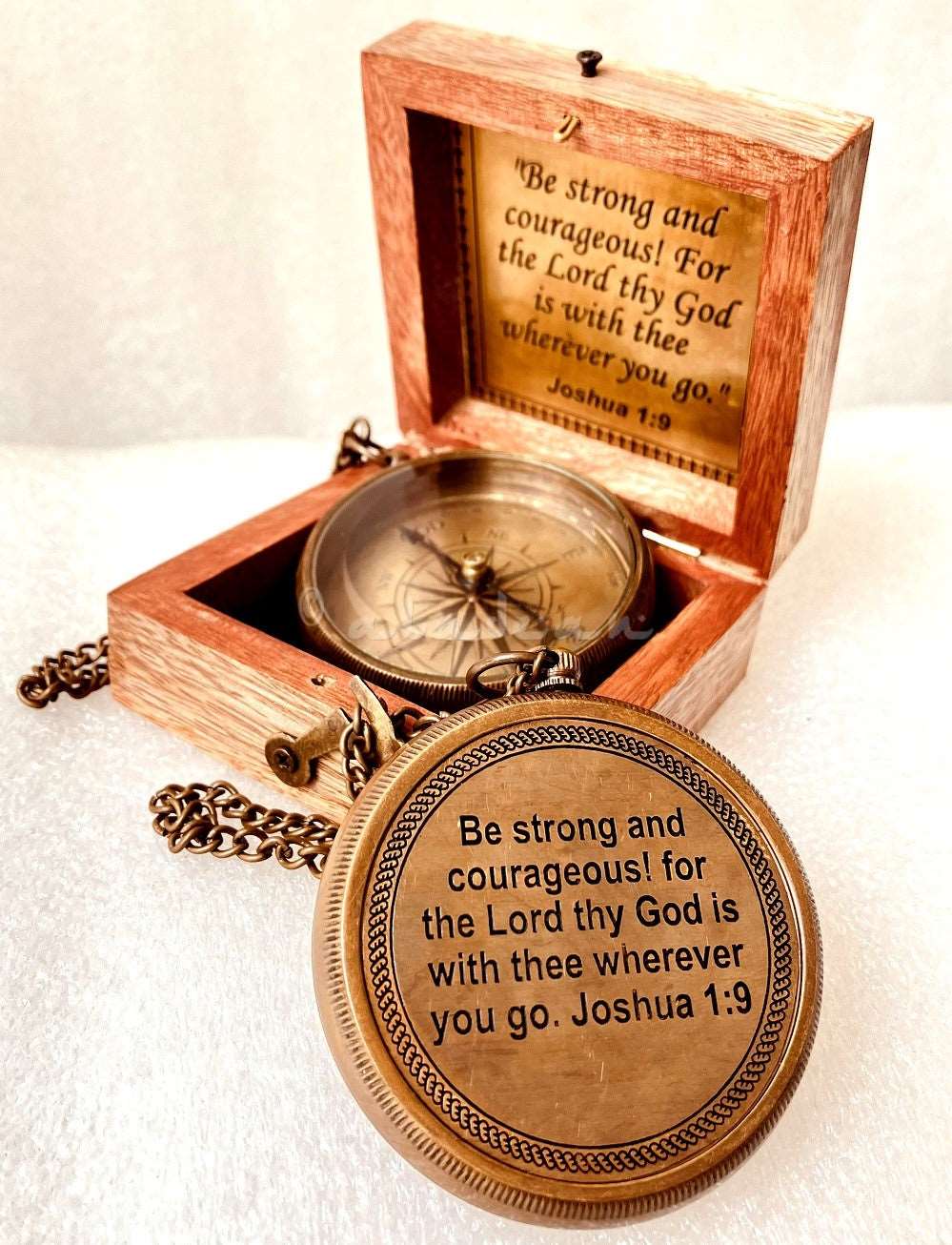
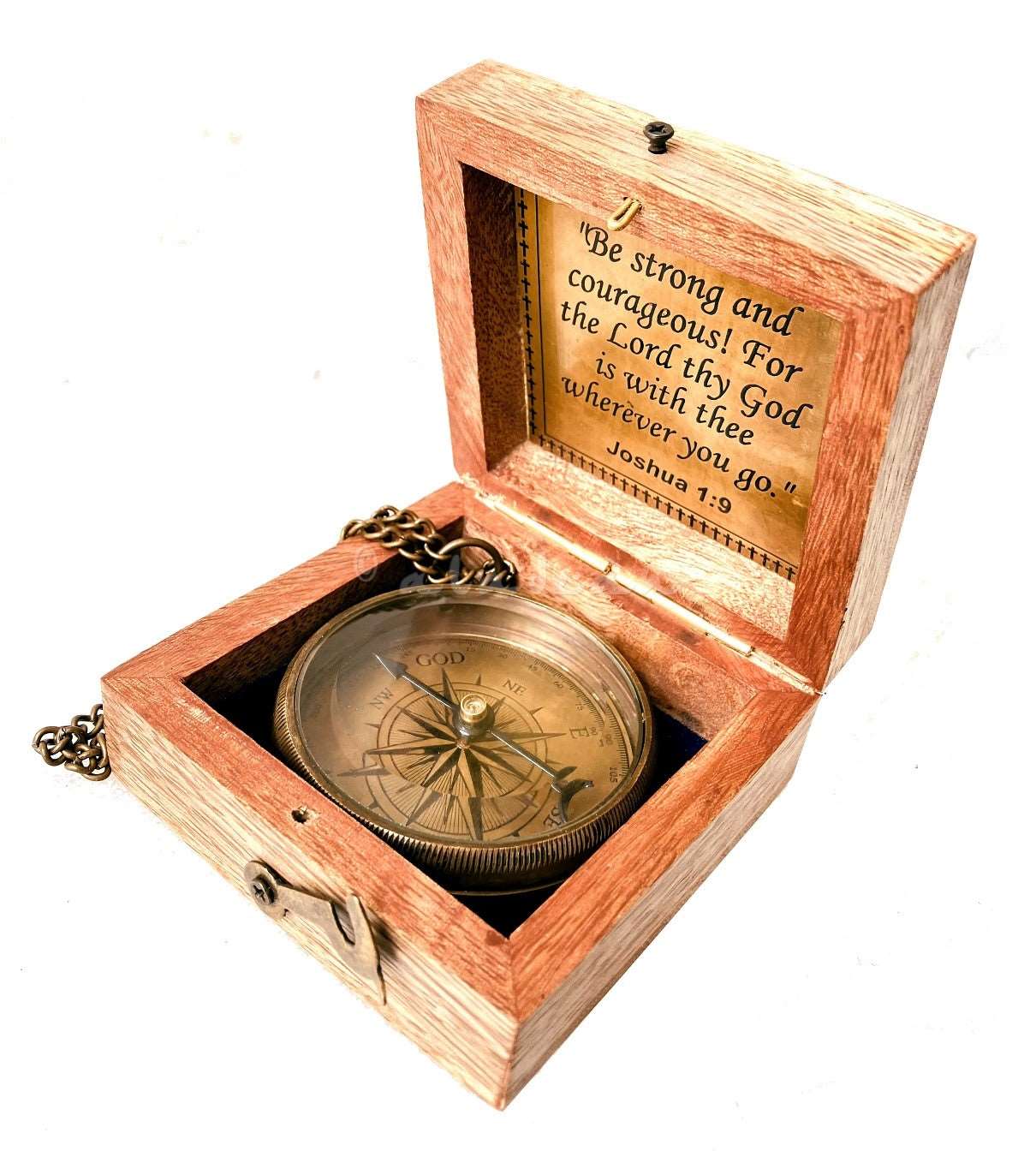
- Religiöser Messing-Kompass als Geschenk – „Sei stark und mutig“, Josua 1,9 – Der primäre Kompass. Handgefertigtes Messing, graviert mit Josua 1,9. Für jede Schlacht, jeden Meilenstein, jeden Menschen, der diesen Befehl hören muss.
- Gravierter Messing-Kompass „Sei stark & mutig“ – Josua-Zitat – Eine Premium-Variante mit dem vollständigen Josua-Zitat. Für den Sammler, der den vollständigen Vers möchte.
- Tischuhr mit Kompass aus Messing – „Sei stark und mutig“ graviertes Geschenk – Für den Schreibtisch, das Arbeitszimmer, das Büro – eine tägliche Erinnerung daran, dass Zeit und Mut in Gottes Händen liegen.
- Piraten-Fernrohr, 15 Zoll, graviert – „Sei stark und mutig“, Vintage-Teleskop – Für den Abenteurer, den Entdecker, die Person, die immer zum Horizont blickt.
- Gravierter Messingkompass — Möge dein Glaube dich leiten — Für jemanden, dessen Mut im Glauben verwurzelt ist. Ein begleitender Vers zu Josua 1,9.
- Messingkompass „Gott leite mich“ — Religiöses Geschenk des Glaubens — Das Gebet, nach dem Josua lebte. Für jemanden, der jede Reise mit dieser Bitte beginnt.
Teil 10: Mehrsprachige Geschenkbotschaften — Sei stark und mutig auf der ganzen Welt
Englisch — USA, UK, Australien, Kanada, Irland
Beliebte Suchbegriffe: be strong and courageous gift | joshua 1:9 compass | be strong and courageous engraved | religious gift for confirmation | christian courage gift | joshua 1:9 engraved gift | do not be afraid gift | meaningful religious gift 2026 | be strong and courageous compass
Geschenkbotschaften:
- "Sei stark und mutig. Fürchte dich nicht. Gott ist mit dir, wohin du auch gehst. — Josua 1,9"
- "Mut ist nicht das Fehlen von Angst. Es ist Glaube in Bewegung."
- "Er ist dir bereits vorausgegangen. Jeden Schritt, den du machst, geht Er mit dir."
- "Du wurdest nicht geschaffen, um dort zu bleiben, wo es sicher ist. Sei stark. Sei mutig. Geh."
- "Habe ich dir nicht befohlen? Sei stark und mutig. — Gott, Josua 1,9"
Deutsch — Deutschland, Österreich, Schweiz
Beliebte Suchbegriffe: Sei stark und mutig Geschenk | Josua 1:9 graviert | religiöses Geschenk Konfirmation | christliches Mut Geschenk | Josua 1:9 Kompass | Bibelvers Mut graviert | religiöses Erbstück Geschenk 2026
Geschenkbotschaften:
- "Sei getrost und unverzagt. Fürchte dich nicht. Der HERR, dein Gott, ist mit dir. — Josua 1,9"
- "Mut ist nicht das Fehlen von Angst. Es ist Glaube in Bewegung."
- "Er ist schon vor dir hergegangen. Jeden Schritt, den du gehst, geht Er mit dir."
Français — Frankreich, Belgien, Kanada
Termes de recherche populaires: sois fort et courageux cadeau | Josué 1:9 gravé | cadeau religieux confirmation | cadeau chrétien courage | Josué 1:9 boussole | verset biblique courage gravé | cadeau foi heirloom 2026
Messages cadeaux:
- "Fortifie-toi et prends courage. Ne t'effraie point. L'Éternel ton Dieu est avec toi. — Josué 1:9"
- "Le courage n'est pas l'absence de peur. C'est la foi en mouvement."
- "Il est déjà allé devant toi. Chaque pas que tu fais, Il le fait avec toi."
Español — Spanien, Mexiko, USA (hispanisch)
Términos de búsqueda populares: sé fuerte y valiente regalo | Josué 1:9 grabado | regalo religioso confirmación | regalo cristiano valentía | Josué 1:9 brújula | versículo bíblico valentía grabado | regalo fe heirloom 2026
Mensajes de regalo:
- "Esfuérzate y sé valiente. No temas. Jehová tu Dios estará contigo. — Josué 1:9"
- "El valor no es la ausencia del miedo. Es la fe en movimiento."
- "Él ya ha ido delante de ti. Cada paso que das, Él lo da contigo."
Italiano — Italien
Termini di ricerca popolari: sii forte e coraggioso regalo | Giosuè 1:9 inciso | regalo religioso cresima | regalo cristiano coraggio | Giosuè 1:9 bussola | versetto biblico coraggio inciso | regalo fede heirloom 2026
Messaggi regalo:
- "Sii forte e coraggioso. Non temere. Il Signore Iddio tuo sarà con te. — Giosuè 1:9"
- "Il coraggio non è l'assenza della paura. È la fede in movimento."
- "È già andato davanti a te. Ogni passo che fai, lo fa con te."
Teil 11: 8 verwandte Verse — Die nächsten Beiträge in dieser Serie
Josua 1,9 gehört zu einer Reihe von Versen über den Mut, die sich durch die gesamte Bibel ziehen. Jeder von ihnen verdient eine eigene, ausführliche Betrachtung. Hier sind acht Verse, die die Grundlage für die nächsten Beiträge dieser Serie bilden werden – jeder beleuchtet eine andere Dimension derselben Wahrheit.
- Jesaja 41,10 — "Fürchte dich nicht, ich bin mit dir; hab keine Angst, denn ich bin dein Gott. Ich mache dich stark, ich helfe dir, ich halte dich mit meiner rechten Hand." Der Mut-Vers für den Menschen im Exil – wenn alles genommen wurde und Gottes Gegenwart das Einzige ist, was bleibt.
- Psalm 27,1 — "Der Herr ist mein Licht und mein Heil: Vor wem sollte ich mich fürchten? Der Herr ist die Zuflucht meines Lebens: Vor wem sollte ich beben?" Der Mut-Vers, der die Angst mit einer Frage beantwortet – und die Frage beantwortet sich von selbst.
- 5. Mose 31,6 — "Seid mutig und stark, fürchtet euch nicht und habt keine Angst vor ihnen; denn der Herr, dein Gott, geht selbst mit dir. Er lässt dich nicht fallen und verlässt dich nicht." Der ursprüngliche Befehl – Mose an das Volk. Das Fundament, auf dem Josua 1,9 aufbaut.
- Römer 8,31 — "Ist Gott für uns, wer kann dann gegen uns sein?" Der Mut-Vers des Neuen Testaments – die logische Schlussfolgerung aus allem, was Josua 1,9 impliziert. Wenn Gott gegenwärtig ist, was gibt es dann zu fürchten?
- 2. Timotheus 1,7 — "Gott hat uns nicht einen Geist der Furcht gegeben, sondern den Geist der Kraft, der Liebe und der Besonnenheit." Der Vers, der die Quelle der Angst benennt – und die Quelle des Mutes. Angst kommt nicht von Gott. Kraft, Liebe und Besonnenheit tun es.
- Philipper 4,6-7 — "Sorgt euch um nichts, sondern bringt in jeder Lage betend und flehend eure Bitten mit Dank vor Gott! Und der Friede Gottes, der alles Verstehen übersteigt, wird eure Herzen und eure Gedanken in Christus Jesus bewahren." Der Mut-Vers für Ängstliche – der praktische Weg von der Angst zum Frieden.
- 1. Johannes 4,18 — "Furcht gibt es nicht in der Liebe, sondern die vollkommene Liebe vertreibt die Furcht." Der tiefgründigste Mut-Vers – derjenige, der an die Wurzel geht. Angst wird nicht durch Willenskraft oder Entschlossenheit überwunden. Sie wird durch Liebe überwunden. Vollkommene Liebe. Die Liebe Gottes.
- Psalm 46,2-3 — "Gott ist unsere Zuflucht und Stärke, ein bewährter Helfer in aller Not. Deshalb fürchten wir uns nicht, auch wenn die Erde bebt und die Berge ins Meer stürzen." Der Mut-Vers für Katastrophen – wenn das Schlimmste eintritt und Gott dennoch die Zuflucht bleibt.
Ein letztes Wort — An alle, die an ihrem eigenen Jordan stehen
Du liest dies, weil etwas in deinem Leben gerade Mut erfordert.
Vielleicht ist es eine Entscheidung, die du aufgeschoben hast, weil so viel auf dem Spiel steht. Vielleicht ist es ein Gespräch, das du führen musst, für das du aber die Worte nicht findest. Vielleicht ist es eine Diagnose, ein Verlust, ein Umbruch, eine Schwelle, an der du stehst und die du nicht überwinden kannst. Vielleicht ist es etwas so Einfaches – und so Gewaltiges – wie nicht zu wissen, was als Nächstes kommt.
Josua stand am überfluteten Jordan. Auf der anderen Seite warteten befestigte Städte und professionelle Armeen. Hinter ihm standen zwei Millionen Menschen, die auf ihn zählten. Und er hatte Angst.
Gott hat den Fluss nicht entfernt. Er hat die Armeen nicht beseitigt. Er hat die Aufgabe nicht kleiner oder die Risiken geringer gemacht. Er sprach vier Worte:
Sei stark und mutig.
Und dann sagte Er das Einzige, was diese vier Worte möglich macht:
Denn der Herr, dein Gott, ist mit dir, wohin du auch gehst.
Das ist immer noch wahr. Für dich. Genau jetzt. In allem, dem du gegenüberstehst.
Der Fluss ist real. Die Angst ist real. Und Gott ist mit dir. Wohin du auch gehst.
Entdecke die Kollektion: Religiöse Geschenke — Handgefertigt & graviert | Shop für gravierte Messingkompasse | Geschenke zur Kommunion | Geschenke zum Abschluss | Firmengeschenke | Individuelle Gravur — Deine Worte für die Ewigkeit
Produkte „Sei stark und mutig“: Kompass „Sei stark und mutig“ — Josua 1,9 | Gravierter Messingkompass „Sei stark und mutig“ | Tischuhr mit Kompass — Sei stark und mutig | Vintage-Teleskop „Sei stark und mutig“ | Kompass „Gott leite mich“
Weiterführende Literatur: Vertraue auf den Herrn — Sprüche 3,5 Vollständiger Leitfaden | Personalisierte Geschenkideen | Geschenkinspiration & Ideen | Produktleitfäden & Ratgeber
Kontakt
E-Mail: sales@aladean.com | Website: www.aladean.com
Jeder Kompass in unserer Kollektion „Sei stark und mutig“ wird von erfahrenen Kunsthandwerkern gefertigt und kann mit den Worten graviert werden, die dir am wichtigsten sind — in über 40 Sprachen. Wir versenden in über 100 Länder weltweit.
ALADEAN — Handgefertigte religiöse Geschenke & gravierte Erbstücke seit 2009