
Do Not Fear, For I Am With You — The Complete Guide to Isaiah 41:10: Meaning, Hebrew, Every Version, Every Language & Why It Becomes the Most Powerful Gift for Every Hard Season

The Most Powerful Anti-Fear Promise in All of Scripture
There is a moment in every life when fear is not a feeling to be managed. It is a weight to be carried — heavy, physical, relentless. The kind of fear that wakes you at three in the morning. The kind that sits in your chest during the diagnosis, the phone call, the conversation you have been dreading. The kind that makes the future feel like a wall rather than a road.
Into that moment, God speaks ten words that have been carrying people through the worst of human experience for nearly three thousand years:
"Do not fear, for I am with you; do not be dismayed, for I am your God."
And then — as if ten words were not enough — He adds four more promises:
"I will strengthen you and help you; I will uphold you with my righteous right hand."
Six promises. One verse. The most complete statement of divine support in all of Scripture.
Isaiah 41:10 was not written for people who are doing well. It was written for people who have lost everything — who are in exile, stripped of their home, their temple, their king, their identity as a nation. It was written for the moment when the worst has already happened and the question is not how to avoid suffering but how to survive it.
That is why it has spoken to every generation since. Not because it promises that the hard thing will not happen. But because it promises that when it does — when you are standing at the edge of the storm, when the diagnosis comes, when the loss is real and the fear is overwhelming — you will not be alone. God is with you. He is your God. He will strengthen you. He will help you. He will hold you up with His righteous right hand.
This is the complete guide to Isaiah 41:10 — one of the most searched, most loved, most needed verses in all of Scripture.
Explore: Religious Gifts — Handcrafted & Engraved by Aladean

Part 1: The Context — Who God Was Speaking To, and Why It Matters
To understand why Isaiah 41:10 is so powerful, you have to understand who God was speaking to when He said it — because the context transforms the promise from a general encouragement into something far more specific and far more extraordinary.
Isaiah 40-55 is known as the Book of Consolation — the section of Isaiah written to the people of Israel during or in anticipation of the Babylonian exile. This was not a minor difficulty. This was the complete destruction of everything that defined Israel as a nation: the Temple had been burned, Jerusalem had been razed, the king had been taken captive, and the people had been marched hundreds of miles to a foreign land where they would live as exiles for seventy years.
They had lost their home. They had lost their worship. They had lost their political identity. Many of them had lost family members to the violence of the conquest. And the theological crisis was as severe as the practical one: if God had allowed this to happen, was He still their God? Was He still in control? Had He abandoned them?
Into that darkness — into the deepest collective crisis in Israel's history — God speaks Isaiah 41:10. And the first thing He says is not "here is my plan" or "here is how this will be resolved." The first thing He says is:
Do not fear. I am with you.
Not "the situation is not as bad as you think." Not "this will be over soon." But: I am with you. In this. Right now. In the exile, in the loss, in the darkness. I am here.
This is the context that makes Isaiah 41:10 the verse for every hard season — not just the hard seasons that resolve quickly, but the ones that last. The ones where the situation does not improve on your timeline. The ones where the only thing that changes is your understanding of who is with you in it.
God was speaking to exiles. He is still speaking to exiles — everyone who feels displaced, stripped of what they had, uncertain whether they will find their way home. The promise has not changed. The presence has not changed. I am with you. I am your God. I will strengthen you. I will help you. I will uphold you.

Part 2: The Full Verse — Six Promises in Two Sentences
Isaiah 41:10 is remarkable for its density — six distinct promises packed into two sentences, each one addressing a different dimension of human fear and need. Understanding each promise separately reveals the extraordinary completeness of what God is offering.
"So do not fear, for I am with you; do not be dismayed, for I am your God. I will strengthen you and help you; I will uphold you with my righteous right hand."
— Isaiah 41:10 (NIV)
Promise 1 — "Do Not Fear"
The first promise is a command — and like all divine commands, it is also a provision. God does not command what He does not enable. When He says "do not fear," He is not dismissing the reality of the fear. He is providing the reason and the power to move beyond it. The command is grounded in what follows: do not fear, because I am with you. The reason for the command is the promise that accompanies it.
Promise 2 — "For I Am With You"
The first reason given for not fearing is the most fundamental: divine presence. Not divine power (that comes later). Not divine plan (that is not mentioned at all). The first and most basic reason to not fear is simply: I am with you. The God of the universe is present. In this moment. In this situation. With you specifically. The presence precedes the power — because presence is what fear most fundamentally denies. Fear says: you are alone in this. God says: you are not.
Promise 3 — "Do Not Be Dismayed"
The second prohibition addresses something different from fear. Dismay — the Hebrew word shaat — is the collapse of the will, the shattering of resolve, the state of being broken by what has happened. Where fear is acute and immediate, dismay is chronic and erosive. It is the slow loss of the ability to keep going. God addresses both: the sharp fear of the moment and the grinding discouragement of the long season.
Promise 4 — "For I Am Your God"
The second reason given is relational and covenantal: I am your God. Not just a God. Not just the God. Your God — the God who has entered into a specific, personal, covenant relationship with you. This is the language of belonging. You belong to Him. He belongs to you. The relationship is not contingent on your circumstances or your performance. It is a covenant — and covenants do not dissolve in exile.
Promise 5 — "I Will Strengthen You and Help You"
The third and fourth promises are active — God will do something. He will strengthen (the Hebrew amats — the same word used in Joshua 1:9, "be strong and courageous"). He will help (azar — to surround, to protect, to come to the aid of). These are not passive promises of presence. They are active commitments to intervene — to add strength where strength is failing, to provide help where help is needed. See our complete guide: Be Strong and Courageous — Joshua 1:9 Complete Guide.
Promise 6 — "I Will Uphold You With My Righteous Right Hand"
The sixth and final promise is the most physical and the most intimate. Uphold — the Hebrew tamak — means to grasp, to hold firmly, to support from beneath. The image is of a hand reaching down and gripping the person who is falling — not letting them go, holding them up when they cannot hold themselves up. And the hand is the righteous right hand — the hand of power, of authority, of covenant faithfulness. God is not just watching. He is holding. Firmly. With His own hand.
Together, these six promises form the most complete statement of divine support in Scripture: God is present (Promise 2), God is in relationship (Promise 4), God actively strengthens (Promise 5a), God actively helps (Promise 5b), and God physically upholds (Promise 6). Every dimension of human need in a hard season is addressed.

Part 3: The Original Hebrew — What the Words Really Mean
The English translation of Isaiah 41:10 is powerful. But the Hebrew original is extraordinary — and understanding the key words reveals dimensions of the promise that the English only partially captures.
יָרֵא (Yare) — "Fear"
The Hebrew word for "fear" in this verse is יָרֵא (yare) — the most common word for fear in the Hebrew Bible, appearing over 300 times. Yare covers the full spectrum of fear — from reverent awe of God to the terror of mortal danger. In Isaiah 41:10, the context is the latter: the existential fear of a people who have lost everything and do not know if they will survive.
The command "do not yare" is not a command to stop feeling afraid. It is a command to not be controlled by fear — to not let fear be the final word, the governing reality, the thing that determines your response. The presence of God is a larger reality than the fear. Act from the larger reality.
שָׁעָה (Shaat) — "Be Dismayed"
The Hebrew word translated "dismayed" is שָׁעָה (shaat) — to look around in panic, to be shattered, to be broken by what you see. It is the word for the person who looks at their circumstances and is undone by them — whose resolve collapses, whose hope evaporates, who cannot find a way to keep going.
God addresses shaat specifically because it is different from yare. Fear is the acute response to threat. Shaat is the chronic response to overwhelming circumstances — the slow erosion of the will to continue. Both are real. Both are addressed. God's presence and covenant relationship are the answer to both.
אָמַץ (Amats) — "Strengthen"
The Hebrew word for "strengthen" is אָמַץ (amats) — the same word used in Joshua 1:9 ("be strong and courageous") and in David's charge to Solomon in 1 Chronicles 28:20. Amats means to be resolute, to be firm, to press forward with determination. When God says "I will amats you," He is promising to give you the inner resolve that you do not currently have — the determination to keep going when everything in you wants to stop.
This is not the strength of someone who is not afraid. It is the strength of someone who is afraid — and is given, from outside themselves, the resolve to act anyway. The same strength God commanded Joshua to have, He promises to give to the exiles of Isaiah 41. And to you.
עָזַר (Azar) — "Help"
The Hebrew word for "help" is עָזַר (azar) — to surround, to protect, to come to the aid of. Azar appears over 80 times in the Hebrew Bible and is one of the most significant words for divine assistance. It is the word used in Psalm 121:2 — "my help comes from the Lord, the Maker of heaven and earth." It is the word used in Psalm 46:1 — "God is our refuge and strength, an ever-present help in trouble."
Azar is not passive assistance. It is active intervention — God surrounding the person in need, coming to their aid, providing what they cannot provide for themselves. The help of God is not a suggestion or a resource. It is a presence that surrounds and protects.
תָּמַךְ (Tamak) — "Uphold"
The final Hebrew word is תָּמַךְ (tamak) — to grasp, to hold firmly, to support from beneath. The image is physical and intimate: a hand gripping the person who is falling, holding them up when they cannot hold themselves up. Tamak appears in Psalm 37:24 — "though he may stumble, he will not fall, for the Lord upholds him with his hand." The same word, the same image, the same promise.
The phrase "righteous right hand" adds two dimensions: righteous (tsedek — just, faithful, covenant-keeping) and right hand (yamin — the hand of power and authority in Hebrew culture). God upholds with the hand that is both powerful and faithful. He will not let go. He cannot let go — because letting go would be a violation of His own righteousness, His own covenant faithfulness.

Part 4: Every Major Bible Version — What Changes, What Stays
Isaiah 41:10 has been translated into English in every major Bible version. Each translation makes different choices — and those choices reveal different dimensions of the same promise.
King James Version (KJV) — 1611
"Fear thou not; for I am with thee: be not dismayed; for I am thy God: I will strengthen thee; yea, I will help thee; yea, I will uphold thee with the right hand of my righteousness."
Character: Majestic, formal, ancient. The repetition of "yea" — "yea, I will help thee; yea, I will uphold thee" — creates a rhythm of accumulating assurance, each promise building on the last. "The right hand of my righteousness" is a beautiful rendering — the righteousness is the quality of the hand, not just an attribute of God. For four centuries this has been the version memorized by English-speaking Christians facing their hardest seasons.
New International Version (NIV) — 1978/2011
"So do not fear, for I am with you; do not be dismayed, for I am your God. I will strengthen you and help you; I will uphold you with my righteous right hand."
Character: Clear, direct, contemporary. The opening "So" connects the verse to its context — this promise flows from everything God has already said. The most popular version for engraving due to its clarity, balance, and accessibility. The six promises are cleanly structured in three parallel pairs.
English Standard Version (ESV) — 2001
"Fear not, for I am with you; be not dismayed, for I am your God; I will strengthen you, I will help you, I will uphold you with my righteous right hand."
Character: Precise, literary, rhythmically powerful. The ESV's structure — six short clauses separated by semicolons — creates a staccato rhythm of accumulating promises. Each clause stands alone. Each is complete. Together they build to the final image of the righteous right hand. The most poetically structured of all the major versions.
New Living Translation (NLT) — 1996/2015
"Don't be afraid, for I am with you. Don't be discouraged, for I am your God. I will strengthen you and help you. I will hold you up with my victorious right hand."
Character: Warm, accessible, emotionally immediate. The NLT's "don't be discouraged" for shaat is the most psychologically accurate rendering — discouragement is exactly what shaat describes. "Victorious right hand" is a striking choice — it emphasizes not just the faithfulness of God's hand but its power to win. The hand that upholds is the hand that has already won.
The Message (MSG) — 2002
"Don't panic. I'm with you. There's no need to fear for I'm your God. I'll give you strength, I'll help you, I'll hold you steady, keep a firm grip on you."
Character: Urgent, conversational, almost startling. "Don't panic" is the most contemporary rendering of yare — and perhaps the most immediately relatable for a generation that knows exactly what panic feels like. "Keep a firm grip on you" is the most tactile rendering of tamak — the image of God's hand gripping you, refusing to let go, holding on even when you cannot hold on yourself.
Amplified Bible (AMP) — 2015
"Do not fear [anything], for I am with you; Do not be afraid, for I am your God. I will strengthen you, be assured I will help you; I will certainly take hold of you with My righteous right hand [a hand of justice, of power, of victory, of salvation]."
Character: Expansive, explanatory, theologically rich. The parenthetical "[a hand of justice, of power, of victory, of salvation]" unpacks the full meaning of "righteous right hand" — it is not just one thing but four: justice, power, victory, and salvation. The AMP reminds us that the hand that upholds us is the hand that has the authority and power to do everything it promises.
New King James Version (NKJV) — 1982
"Fear not, for I am with you; Be not dismayed, for I am your God. I will strengthen you, Yes, I will help you, I will uphold you with My righteous right hand."
Character: The bridge between KJV majesty and modern readability. Retains the "Yes" of the KJV's "yea" — the emphatic affirmation that each promise is certain, not conditional. The capitalization of "My righteous right hand" is a theological statement: this is not a human hand. It is the divine hand — infinite in its power, perfect in its faithfulness.
Christian Standard Bible (CSB) — 2017
"Do not fear, for I am with you; do not be afraid, for I am your God. I will strengthen you; I will help you; I will hold on to you with my righteous right hand."
Character: Balanced, readable, academically rigorous. "Hold on to you" is the most relational rendering of tamak — not just upholding from beneath but actively holding on, the way a parent holds a child's hand. God is not just supporting you from below. He is holding on to you — actively, intentionally, refusing to let go.

Part 5: Isaiah 41:10 in 10+ Languages — The Promise That Crosses Every Border
The command "do not fear" has been spoken in every language on earth — because fear is universal. Every culture, every language, every human being knows what it means to be afraid. Here is Isaiah 41:10 in ten languages, with notes on the cultural resonance of each.
Hebrew — The Original
אַל-תִּירָא כִּי עִמְּךָ-אָנִי אַל-תִּשְׁתָּע כִּי-אֲנִי אֱלֹהֶיךָ אִמַּצְתִּיךָ אַף-עֲזַרְתִּיךָ אַף-תְּמַכְתִּיךָ בִּימִין צִדְקִי
Al tira ki immecha ani, al tishtaa ki ani Elohecha, imatzticha af azarticha af temachticha bimin tsidki.
Cultural note: In Hebrew, the verse is spoken entirely in the first person by God — six consecutive divine commitments, each one more intimate than the last. The Hebrew reader hears this as God speaking directly, personally, urgently. The accumulation of "af" (also, moreover, even) before the final two promises creates a sense of God adding promise upon promise — as if He wants to make absolutely certain that the person knows they are held.
Greek — The Septuagint (LXX)
Μὴ φοβοῦ, μετὰ σοῦ γάρ εἰμι· μὴ πλανῶ, ἐγὼ γάρ εἰμι ὁ Θεός σου· ἐνίσχυσά σε καὶ ἐβοήθησά σοι καὶ ἀντελαβόμην σου τῇ δεξιᾷ τῇ δικαίᾳ μου.
Cultural note: The Greek Septuagint was the Bible of the early Church — the version Paul quoted, the version the first Christians read. The Greek word for "help" is boetheo — to run to the cry of, to come to the aid of. The image is of God running toward the person in need. The Greek reader hears this verse as God sprinting to their side.
Latin — The Vulgate
Ne timeas, quia ego tecum sum; ne declines, quia ego Deus tuus; confortavi te et auxiliatus sum tibi et suscepit te dextera iusti mei.
Cultural note: Jerome's Latin uses confortavi (I have strengthened — the root of the English "comfort") and auxiliatus sum (I have helped — the root of "auxiliary"). The Latin tradition hears this verse as God having already acted — the perfect tense suggests that the strengthening and helping are already accomplished facts, not just future promises. "Suscepit te" — I have taken you up, I have received you — is the most tender rendering of tamak in any language.
German — Deutsch
Fürchte dich nicht, denn ich bin bei dir; weiche nicht, denn ich bin dein Gott! Ich stärke dich, ich helfe dir auch, ich halte dich durch die rechte Hand meiner Gerechtigkeit.
Popular Search Terms: Fürchte dich nicht Geschenk | Jesaja 41:10 graviert | religiöses Geschenk schwere Zeit | christliches Trost-Geschenk | Jesaja 41:10 Kompass | Bibelvers Mut graviert | religiöses Erbstück Geschenk Muttertag 2026
Gift Messages:
- "Fürchte dich nicht, denn ich bin bei dir. Ich stärke dich und helfe dir. — Jesaja 41:10" (Do not fear, for I am with you. I will strengthen you and help you.)
- "Die Angst ist real. Aber Er ist es auch. Und Er hält dich." (Fear is real. But so is He. And He is holding you.)
- "Du bist nicht allein in diesem. Er ist bei dir. Jetzt. In diesem Moment." (You are not alone in this. He is with you. Now. In this moment.)
French — Français
Ne crains pas, car je suis avec toi; ne te laisse pas abattre, car je suis ton Dieu; je te fortifie, je viens à ton secours, je te soutiens de ma droite triomphante.
Termes de recherche populaires: ne crains pas car je suis avec toi cadeau | Ésaïe 41:10 gravé | cadeau religieux temps difficile | cadeau chrétien réconfort | Ésaïe 41:10 boussole | cadeau foi courage Fête des Mères 2026
Messages cadeaux:
- "Ne crains pas, car je suis avec toi. Je te fortifie et viens à ton secours. — Ésaïe 41:10" (Do not fear, for I am with you. I will strengthen you and help you.)
- "La peur est réelle. Mais Lui aussi. Et Il te tient." (Fear is real. But so is He. And He is holding you.)
- "Tu n'es pas seul dans cela. Il est avec toi. Maintenant. Dans ce moment." (You are not alone in this. He is with you. Now. In this moment.)
Spanish — Español
No temas, porque yo estoy contigo; no te desalientes, porque yo soy tu Dios. Te fortaleceré, ciertamente te ayudaré, sí, te sostendré con la diestra de mi justicia.
Términos de búsqueda populares: no temas porque yo estoy contigo regalo | Isaías 41:10 grabado | regalo religioso tiempos difíciles | regalo cristiano consuelo | Isaías 41:10 brújula | regalo fe valor Día de la Madre 2026
Mensajes de regalo:
- "No temas, porque yo estoy contigo. Te fortaleceré y te ayudaré. — Isaías 41:10" (Do not fear, for I am with you. I will strengthen you and help you.)
- "El miedo es real. Pero Él también lo es. Y Él te sostiene." (Fear is real. But so is He. And He is holding you.)
- "No estás solo en esto. Él está contigo. Ahora. En este momento." (You are not alone in this. He is with you. Now. In this moment.)
Italian — Italiano
Non temere, perché io sono con te; non ti smarrire, perché io sono il tuo Dio; ti fortifico, ti vengo anche in aiuto, ti sostengo con la destra della mia giustizia.
Termini di ricerca popolari: non temere perché io sono con te regalo | Isaia 41:10 inciso | regalo religioso momenti difficili | regalo cristiano conforto | Isaia 41:10 bussola | regalo fede coraggio Festa della Mamma 2026
Messaggi regalo:
- "Non temere, perché io sono con te. Ti fortifico e ti vengo in aiuto. — Isaia 41:10" (Do not fear, for I am with you. I will strengthen you and help you.)
- "La paura è reale. Ma anche Lui lo è. E ti sta tenendo." (Fear is real. But so is He. And He is holding you.)
- "Non sei solo in questo. Lui è con te. Ora. In questo momento." (You are not alone in this. He is with you. Now. In this moment.)
Portuguese — Português
Não temas, porque eu sou contigo; não te assombres, porque eu sou o teu Deus; eu te fortaleço, e te ajudo, e te sustento com a minha destra fiel.
Termos de pesquisa populares: não temas porque eu sou contigo presente | Isaías 41:10 gravado | presente religioso tempos difíceis | presente cristão conforto | Isaías 41:10 bússola | presente fé coragem Dia das Mães 2026
Arabic — العربية
لاَ تَخَفْ لأَنِّي مَعَكَ، لاَ تَتَلَفَّتْ لأَنِّي أَنَا إِلهُكَ. قَوَّيْتُكَ وَأَعَنْتُكَ وَأَمْسَكْتُكَ بِيَمِينِ بِرِّي.
Cultural note: For Arab Christians across Lebanon, Egypt, Syria, Jordan, and the diaspora — many of whom live as minorities in contexts of genuine difficulty and sometimes persecution — Isaiah 41:10 is not an abstract comfort. It is a daily lifeline. The Arabic word for "I held you" — amsaktu — means to grasp firmly, to seize, to not let go. God has already seized them. He is not letting go.
Urdu — اردو
خوف نہ کر کیونکہ میں تیرے ساتھ ہوں۔ گھبرا نہیں کیونکہ میں تیرا خدا ہوں۔ میں تجھے قوت دوں گا اور تیری مدد کروں گا اور اپنے صادق دہنے ہاتھ سے تجھے سنبھالوں گا۔
Cultural note: For Pakistani and Indian Christians, this verse is spoken in contexts of real vulnerability — as minorities navigating majority cultures, as families facing illness or economic hardship, as individuals carrying burdens that feel too heavy. The Urdu word for "I will uphold you" — sambhalunga — means to catch, to steady, to prevent from falling. God will catch you. He will steady you. He will not let you fall.

Part 6: The Echo Across Scripture — Every Time God Says "Do Not Fear"
Isaiah 41:10 is the most complete anti-fear promise in Scripture — but it is not the only one. The command "do not fear" appears over 365 times in the Bible — one for every day of the year. Here is the thread that surrounds and supports Isaiah 41:10.
Genesis 15:1 — The First "Do Not Fear"
"Do not be afraid, Abram. I am your shield, your very great reward."
The first time God says "do not fear" to an individual in Scripture — spoken to Abraham after a battle, when he was vulnerable and uncertain. The same structure as Isaiah 41:10: the command followed by the reason. Do not fear — I am your shield. Three thousand years of "do not fear" begins here.
Joshua 1:9 — The Courage Command
"Be strong and courageous. Do not be afraid; do not be discouraged, for the Lord your God will be with you wherever you go."
The same Hebrew words — yare and shaat — appear in Joshua 1:9 as in Isaiah 41:10. The same command, the same reason: God's presence. The courage of Joshua and the comfort of the exiles are grounded in the same promise. See our complete guide: Be Strong and Courageous — Joshua 1:9 Complete Guide.
Psalm 23:4 — Through the Valley
"Even though I walk through the darkest valley, I will fear no evil, for you are with me; your rod and your staff, they comfort me."
The same promise — divine presence as the reason for fearlessness — in the most beloved psalm in Scripture. The valley of the shadow of death is the place where Isaiah 41:10 is most needed. And in both passages, the answer is the same: you are with me.
Isaiah 43:1-2 — Called by Name
"Do not fear, for I have redeemed you; I have summoned you by name; you are mine. When you pass through the waters, I will be with you; and when you pass through the rivers, they will not sweep over you."
Two chapters after Isaiah 41:10, God repeats the command — and adds the most personal possible reason: I have called you by name. You are mine. The presence of Isaiah 41:10 becomes the ownership of Isaiah 43:1. You belong to God. He will not abandon what is His.
John 14:27 — The Peace That Passes Understanding
"Peace I leave with you; my peace I give you. I do not give to you as the world gives. Do not let your hearts be troubled and do not be afraid."
In the New Testament, Jesus speaks the same command on the night before His death — to disciples who are about to face their own exile, their own loss, their own darkness. The peace He gives is not the absence of difficulty. It is the presence of God in the difficulty. The same promise, three thousand years later, from the same God in human form.
Romans 8:38-39 — Nothing Can Separate
"For I am convinced that neither death nor life, neither angels nor demons, neither the present nor the future, nor any powers, neither height nor depth, nor anything else in all creation, will be able to separate us from the love of God that is in Christ Jesus our Lord."
The New Testament fulfillment of Isaiah 41:10's promise — the presence of God made permanent and unbreakable in Christ. Nothing can separate. Not exile. Not illness. Not loss. Not death. The righteous right hand of Isaiah 41:10 is the love of God in Christ Jesus — and it will not let go.

Part 7: Why Isaiah 41:10 Speaks at Every Stage of Life
Isaiah 41:10 was written for exiles — people who had lost everything. But the fear it addresses is not unique to exile. It is the fear of every person facing something that feels too large, too dark, too uncertain. Here is how the verse speaks at every stage of life.
For the Mother — Afraid for Her Children
There is no fear quite like the fear of a mother for her child — the fear that something will happen to them, that she will not be able to protect them, that the world will hurt them in ways she cannot prevent. Isaiah 41:10 is the verse for every mother who has ever lain awake afraid. Do not fear. I am with you. I will strengthen you. I will uphold you. And — by extension — I am with them too. My righteous right hand holds you both. A compass engraved with these words, given to a mother on Mother's Day, is the declaration that she is not carrying this alone.
For the Person Facing Illness
The diagnosis is the moment when Isaiah 41:10 becomes the most necessary verse in Scripture. Not because it promises healing — it does not. But because it promises presence: I am with you. I am your God. I will strengthen you. I will help you. I will uphold you. Every dimension of what a person needs in a medical crisis is addressed — the acute fear, the chronic discouragement, the need for strength, the need for help, the need to be held when they cannot hold themselves up.
For the Person in Grief
Grief is its own kind of exile — the loss of a person, a relationship, a future that was expected. The dismay of shaat is the dismay of grief: the shattering of the world as it was, the inability to imagine how to keep going. Isaiah 41:10 speaks directly into grief: do not be dismayed. I am your God. I will uphold you with my righteous right hand. The hand that holds the grieving person is the same hand that holds the one they have lost.
For the Graduate — Facing the Unknown
The fear of the graduate is different from the fear of the exile — but it is real. The unmapped future, the pressure to choose correctly, the uncertainty of whether they are enough for what lies ahead. Isaiah 41:10 is the verse for this moment too: do not fear. I am with you. I will strengthen you. The same God who upheld Israel in exile will uphold the graduate in the unknown. See our Graduation Day Gifts collection.
For the Leader — Carrying Impossible Responsibility
Leadership requires a particular kind of courage — the courage to make decisions with incomplete information, to bear responsibility for outcomes you cannot fully control, to stand firm when the pressure to give up is enormous. Isaiah 41:10 is the verse for the leader who is afraid of failing the people who depend on them: I will strengthen you. I will help you. I will uphold you with my righteous right hand.
For Anyone at Two in the Morning
The fear that comes at two in the morning — when the mind runs through every worst-case scenario, when the weight of everything feels unbearable, when the darkness is both literal and metaphorical — is the fear Isaiah 41:10 was written for. Do not fear. I am with you. Right now. In this moment. In this darkness. I am here.

Part 8: Why Isaiah 41:10 Becomes the Most Powerful Engraved Gift for Hard Seasons
Of all the comfort verses in Scripture, Isaiah 41:10 is the most complete — and that completeness is precisely what makes it the most powerful engraved gift for hard seasons.
It addresses both acute fear and chronic discouragement. Most comfort verses address one or the other. Isaiah 41:10 addresses both — the sharp fear of the moment (yare) and the grinding dismay of the long season (shaat). The person who receives this gift is receiving a verse that speaks to every dimension of their experience, not just one.
It gives reasons, not just commands. "Do not fear" alone is not enough — the person who is afraid knows they should not be afraid. What they need is a reason that is larger than the fear. Isaiah 41:10 gives four reasons: I am with you, I am your God, I will strengthen and help you, I will uphold you. The reasons are the gift.
It is physical and intimate. "I will uphold you with my righteous right hand" — the most physical promise in Scripture. God is not watching from a distance. He is holding. Firmly. With His own hand. When this verse is engraved on a compass and placed in the hands of someone who is afraid, the physical act of holding the compass becomes a reminder of the physical promise: He is holding you.
It is the verse for the person who has lost everything. Isaiah 41:10 was written for exiles — people who had lost their home, their temple, their king, their identity. It is the verse for the person who feels they have nothing left. And it tells them: you have God. His presence. His covenant. His strength. His help. His hand. That is not nothing. That is everything.
Our Isaiah 41:10 Gift:
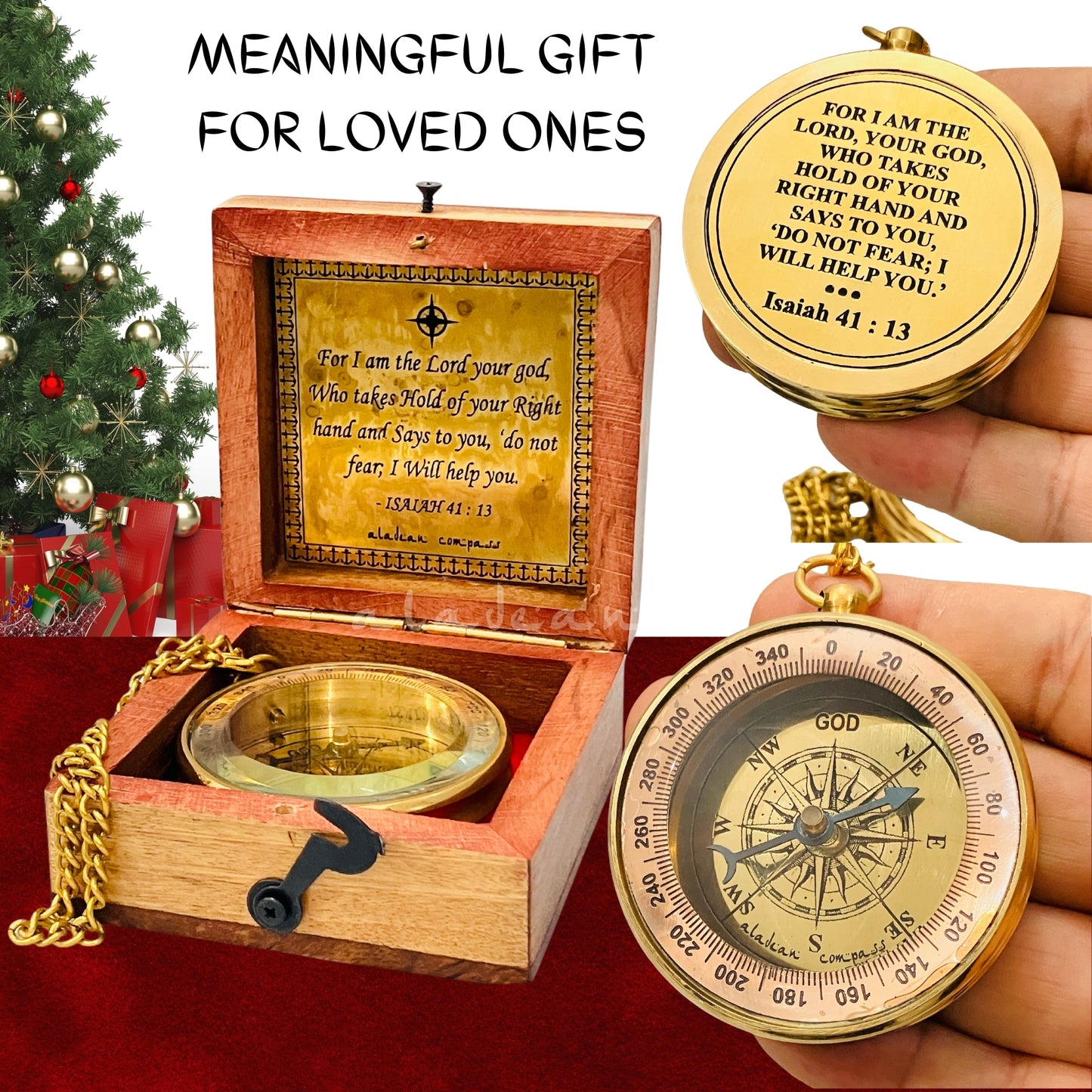
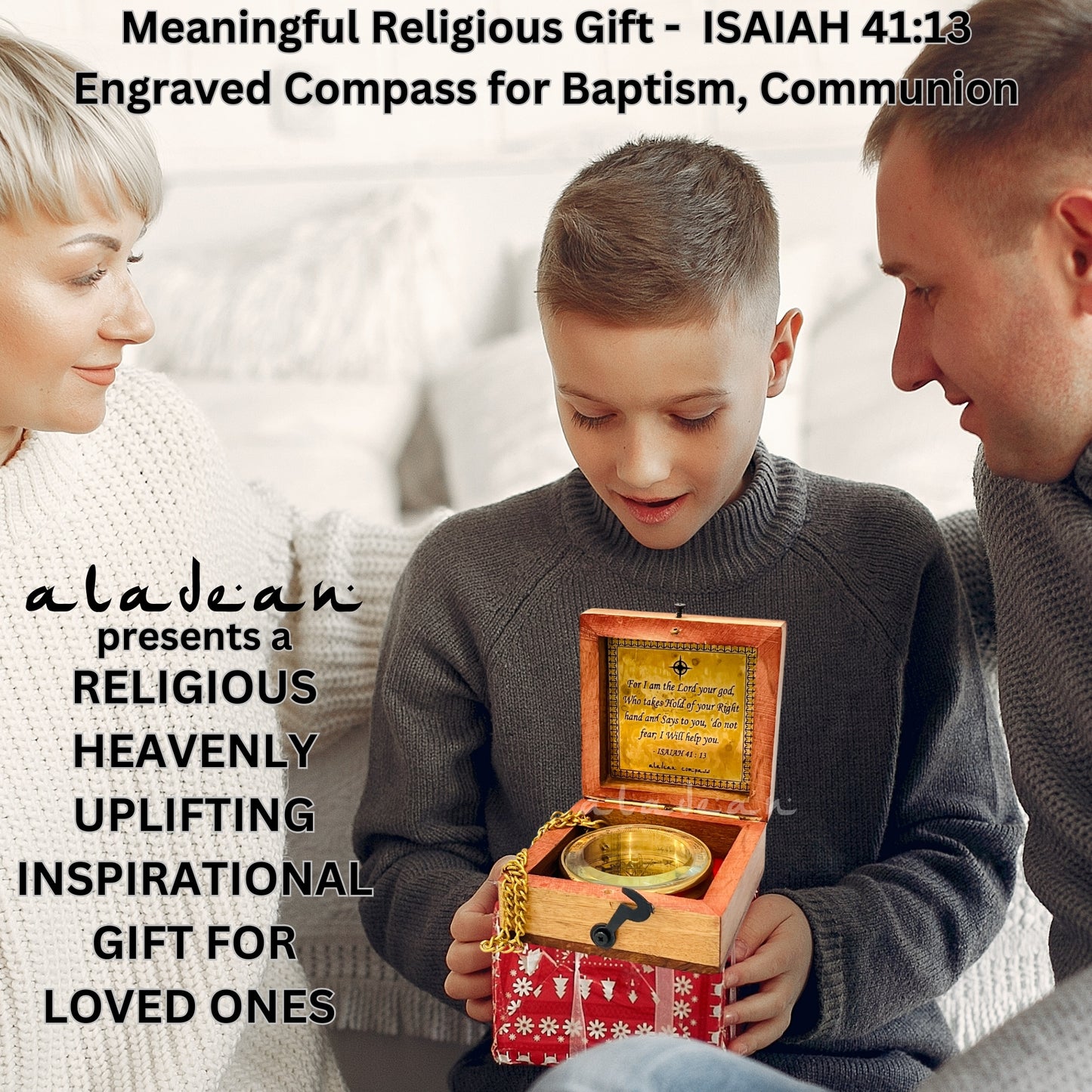
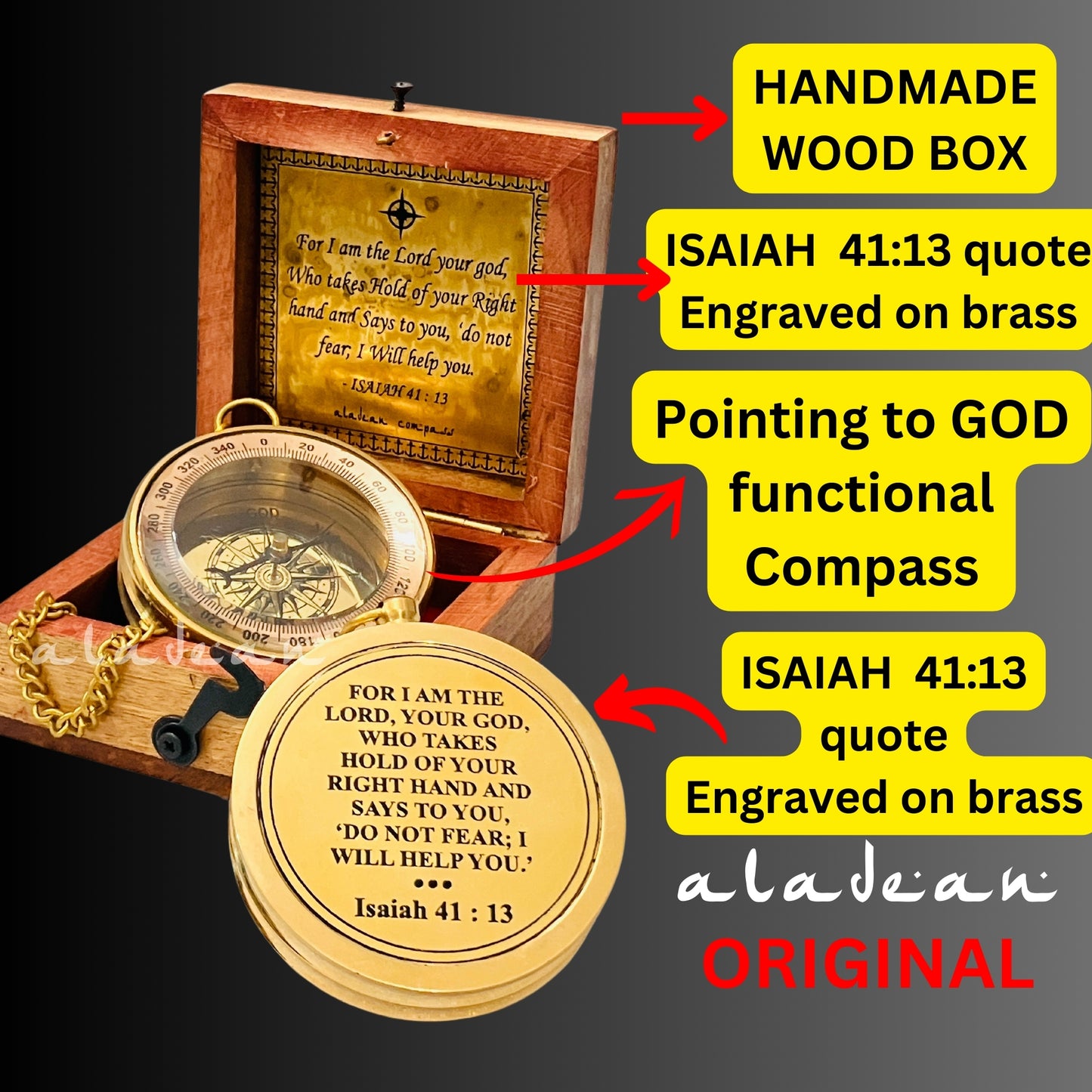
Religious Gift Brass Compass — Divine Path Finder Isaiah 41:13 Engraved
Handcrafted solid brass. Engraved with the promise of divine guidance and presence. For every hard season, every moment of fear, every person who needs to know they are not alone and they are being held.
Related Gifts:
- God Guide Me Brass Compass — Religious Gift of Faith — The prayer of Isaiah 41:10 made physical. For the person who begins every hard day with this request.
- The Lord Will Guide Compass — Psalm 32:8 & Proverbs 3:6 — For the person who needs both the comfort of God's presence and the promise of a straight path forward.
- Be Strong and Courageous Compass — Joshua 1:9 — For the person who needs the courage command alongside the comfort promise.
- Path of God Compass Gift in Wood Box — Premium presentation for the most significant moments of need.

Part 9: Multilingual Gift Messages — Do Not Fear Around the World
English — USA, UK, Australia, Canada, Ireland
Popular Search Terms: do not fear for i am with you gift | isaiah 41:10 compass | isaiah 41:10 engraved gift | religious gift for illness | christian comfort gift | do not be dismayed gift | meaningful religious gift mothers day 2026 | religious gift for hard times | i will uphold you gift | faith courage gift for graduation 2026
Gift Messages:
- "Do not fear, for I am with you. Do not be dismayed, for I am your God. I will strengthen you and help you. I will uphold you with my righteous right hand. — Isaiah 41:10"
- "Fear is real. So is He. And He is holding you."
- "You are not alone in this. He is with you. Now. In this moment."
- "He will strengthen you. He will help you. He will hold you up when you cannot hold yourself up."
- "The hand that holds the stars is holding you. — Isaiah 41:10"
- "For every hard season, every dark night, every moment of fear — He is with you."
- "Don't panic. He's with you. He's your God. He's got you. — Isaiah 41:10"
Deutsch — Germany, Austria, Switzerland
Geschenkbotschaften:
- "Fürchte dich nicht, denn ich bin bei dir. Ich stärke dich und helfe dir. — Jesaja 41:10" (Do not fear, for I am with you. I will strengthen you and help you.)
- "Die Angst ist real. Aber Er ist es auch. Und Er hält dich." (Fear is real. But so is He. And He is holding you.)
- "Du bist nicht allein. Er ist bei dir. Jetzt. In diesem Moment." (You are not alone. He is with you. Now. In this moment.)
Français — France, Belgium, Canada
Messages cadeaux:
- "Ne crains pas, car je suis avec toi. Je te fortifie et viens à ton secours. — Ésaïe 41:10" (Do not fear, for I am with you. I will strengthen you and help you.)
- "La peur est réelle. Mais Lui aussi. Et Il te tient." (Fear is real. But so is He. And He is holding you.)
- "Tu n'es pas seul. Il est avec toi. Maintenant. Dans ce moment." (You are not alone. He is with you. Now. In this moment.)
Español — Spain, Mexico, USA Hispanic
Mensajes de regalo:
- "No temas, porque yo estoy contigo. Te fortaleceré y te ayudaré. — Isaías 41:10" (Do not fear, for I am with you. I will strengthen you and help you.)
- "El miedo es real. Pero Él también lo es. Y Él te sostiene." (Fear is real. But so is He. And He is holding you.)
- "No estás solo. Él está contigo. Ahora. En este momento." (You are not alone. He is with you. Now. In this moment.)
Italiano — Italy
Messaggi regalo:
- "Non temere, perché io sono con te. Ti fortifico e ti vengo in aiuto. — Isaia 41:10" (Do not fear, for I am with you. I will strengthen you and help you.)
- "La paura è reale. Ma anche Lui lo è. E ti sta tenendo." (Fear is real. But so is He. And He is holding you.)
- "Non sei solo. Lui è con te. Ora. In questo momento." (You are not alone. He is with you. Now. In this moment.)
Part 10: 8 Related Verses — The Next Pillar Posts in This Series
- Psalm 23:4 — "Even though I walk through the darkest valley, I will fear no evil, for you are with me." The comfort verse for grief and loss — the valley of the shadow of death. The most searched phrase in Scripture. The companion verse to Isaiah 41:10 for every dark season.
- Joshua 1:9 — "Be strong and courageous. Do not be afraid; do not be discouraged, for the Lord your God will be with you wherever you go." The courage command — the same Hebrew words as Isaiah 41:10, the same reason, the same promise. See our complete guide: Be Strong and Courageous — Joshua 1:9.
- Romans 8:28 — "And we know that in all things God works for the good of those who love him." The promise that the hard season has a purpose — that God is working even in the exile, even in the loss, even in the darkness.
- Jeremiah 29:11 — "For I know the plans I have for you, declares the Lord, plans to prosper you and not to harm you, plans to give you hope and a future." The promise spoken to exiles — the same audience as Isaiah 41:10. God has plans for the person in the hard season. The exile is not the end of the story.
- 2 Timothy 1:7 — "For God has not given us a spirit of fear, but of power and of love and of a sound mind." The New Testament anti-fear verse — identifying the source of fear (not from God) and the alternative (power, love, soundness of mind).
- Philippians 4:6-7 — "Do not be anxious about anything, but in every situation, by prayer and petition, with thanksgiving, present your requests to God. And the peace of God, which transcends all understanding, will guard your hearts and your minds." The practical pathway from fear to peace — the companion verse to Isaiah 41:10 for the anxious heart.
- Isaiah 43:1-2 — "Do not fear, for I have redeemed you; I have summoned you by name; you are mine." The most personal anti-fear promise in Scripture — God knows your name. You belong to Him. He will not abandon what is His.
- Psalm 46:1-2 — "God is our refuge and strength, an ever-present help in trouble. Therefore we will not fear, though the earth give way." The courage verse for catastrophe — when the worst happens, and God is still the refuge. The azar of Isaiah 41:10 expanded into a full psalm of fearless trust.
A Final Word — To Everyone Who Is Afraid Right Now
You are reading this because something in your life is frightening you right now.
Maybe it is a diagnosis. Maybe it is a loss. Maybe it is a future that feels unmapped and overwhelming. Maybe it is the slow, grinding fear of a season that will not end. Maybe it is the two-in-the-morning fear that comes when the world is quiet and the mind will not stop.
God spoke Isaiah 41:10 to people who had lost everything. People who had every reason to be afraid. People whose circumstances were genuinely, objectively terrible. He did not tell them their circumstances were not as bad as they thought. He did not promise that everything would be resolved quickly. He said six things:
Do not fear. I am with you. Do not be dismayed. I am your God. I will strengthen you. I will help you. I will uphold you with my righteous right hand.
Those six things are still true. For you. Right now. In whatever you are facing.
The fear is real. The difficulty is real. The darkness is real.
And He is real. He is with you. He is your God. He is strengthening you. He is helping you. He is holding you with His righteous right hand.
That hand has never let go of anyone it has held. It will not let go of you.
Explore the Collection: Religious Gifts — Handcrafted & Engraved | Engraved Brass Compass Shop | Graduation Day Gifts | Holy Communion Gifts | Custom Engraving — Your Words, Made Permanent
Isaiah 41:10 Gift: Divine Path Finder Compass — Isaiah 41:13 Engraved
Related Products: God Guide Me Compass | The Lord Will Guide Compass | Be Strong and Courageous Compass | Path of God Compass in Wood Box
Related Reading: Be Strong and Courageous — Joshua 1:9 | Trust in the Lord — Proverbs 3:5 | I Will Guide You Along the Best Pathway — Psalm 32:8 | The Lord Will Guide Your Steps — Psalm 32:8 & Proverbs 3:6 | Personalized Gift Ideas
Contact Us
Email: sales@aladean.com | | Website: www.aladean.com
Every compass in our collection is handcrafted by skilled artisans and can be engraved with the words that matter most — in any of 40+ languages. Personalization available for any name, date, message, or dedication. Bulk orders available for churches, schools, and organizations. We ship to 100+ countries worldwide.
ALADEAN — Handcrafted Religious Gifts & Engraved Heirlooms Since 2009